Best First Feature Film:
Boudewijn Koole for Cowboy/ Netherlands
Special Mention/ Silver Bear:
Ursula Meier for L'enfant d'en haut/ Switzerland
Alfred Bauer Award for New Perspectives In Cinema:
Miguel Gomez for Tabu/ Portugal
Silver Bear for Best Actor:
Mikkel Boo Falkesgaard for A Royal Affair/ Denmark
Silver Bear for Best Actress:
Rachel Mwanza for Rebelle/ Canada
Silver Bear For Best Screenplay:
Nikolai Arcel and Rasmus Heisterberg for A Royal Affair/ Denmark
Silver Bear For Outstanding Artistic Contribution:
Cinematographer Lutz Reitemeier for Bai lu yuan/ China
Silver Bear for Best Direction:
Christian Petzold for Barbara/ Germany
Silver Bear/ Grand Prix of the Jury:
Bence Fliegauf for Just The Wind/ Hungary
Golden Bear for Best Film:
Paolo and Vittorio Taviani for Cesare deve morire/ Italy
Showing posts with label Berlinale. Show all posts
Showing posts with label Berlinale. Show all posts
Saturday, 18 February 2012
Friday, 3 February 2012
Berlinale 2012 - Programme/ Competition/ Now Complete

The programme for the International Competition is now complete, the Berlin Film Festival has announced.
Though due to the rescheduled date for the Academy Awards ceremony which has once again been brought forward, the programme does feature less US productions than usual. However, in my opinion that is a loss the Berlin film fest can live with. If anything, it's a gain, not because US films are so bad - no! - but because these films will eventually be released the world over, anyway, and therefore don't really need the support of a major film festival as a launching pad at all.
Let's face it, the main reason why Hollywood used to feature so prominently in the Berlinale's Competition was because of the Hollywood glamour these films added to a festival which otherwise has a dearth in star power - stars, that is, that are known the world over. Not that any film festival - let alone one like the Berlinale which for years has been known as a political festival, and one with a focus on Asian and eastern European cinema - necessarily needs star power or Hollywood glamour. But it's the sponsors that require it. Like everywhere else - money talks, and it's the sponsors providing much needed cold, hard cash, that are calling the shots. At least to a degree. For if French cosmetics giant L'Oreal agrees to shell out some dough they expect to be associated with the likes of Scarlett Johannson or, if unavailable, Paris Hilton (or perhaps not Paris Hilton ...), rather than some, in their eyes, C-List ding-dong from some eastern European country Paris Hilton wouldn't even be able to pinpoint on the map. But every time I see these so-called Hollywood stars schlepping across the red carpet in Berlin's - usually - freezing cold weather, answering the - usually - silly questions by the German media, for some Berlinale entry which - usually - had its US release weeks ago, I'm finding this act, put on for the sake of the sponsors, increasingly ludicrous. Let's face it - Berlin will never be Cannes. Temperatures below zero, the non-existent palm-trees and, of course, the relative absence of Hollywood stars, just can't compete with the splendours of La Croisette. It is my opinion - and it has been for some time - that Berlin would be well advised to distance itself from Cannes. In other words, rather than trying to imitate it, the way to go is to focus on its reputation as a political festival and get completely rid of the titbits of glamour there were, including that silly red carpet. Berlinale discoveries that fall under this category are the festival's strong suit and are generally among the best films to be found in the fest's official programme. Best case in point is last year's Nader and Sirin, which went on to garner awards across the globe.
This year, however, there's little the sponsors can do, anyway, as Hollywood films are just not available for reasons mentioned above. All this, I think, is to the Berlinale's benefit which, in addition to being blessed with the strongest jury in years, now also has a Competition programme to match. And while I can't say much regarding the quality of the films selected yet, at least the programme as a whole seems more consistent, if not to say more interesting, featuring, as it does, an impressive number of films of little known directors, thus doing exactly what a film festival is supposed to do: providing an international platform for new talent.
Find the Berlinale Competition programme HERE!


Thursday, 26 January 2012
Berlinale 2012 - Jury/ International Competition
British film maker Mike Leigh will be head of the international jury of the upcoming Berlin Film Festival. He is joined by French actress Charlotte Gainsbourg, Iranian film maker Asghar Farhadi, French film maker Francois Ozon, Algerian writer Boualem Sansal, German actress Barbara Sukowa, Dutch photographer and film maker Anton Corbijn, and American actor Jake Gyllanhaal.

Mike Leigh

Barbara Sukowa

Boualem Sansal

Charlotte Gainsbourg

Francois Ozon

Jake Gyllenhaal

Anton Corbijn

Asghar Farhadi
It is, in my opinion, the hottest jury in years with big names throughout - big in the sense of both each jury member's fame and popularity as well as their achievements and the quality of their work.
The first-rate jury is matched by a Competition programme which, though not yet complete, sounds very promising consisting as it does almost solely of world premières, thus giving Cannes a run for its money.
It'll be posted here as soon as it's been announced.

Mike Leigh

Barbara Sukowa

Boualem Sansal

Charlotte Gainsbourg

Francois Ozon

Jake Gyllenhaal

Anton Corbijn

Asghar Farhadi
It is, in my opinion, the hottest jury in years with big names throughout - big in the sense of both each jury member's fame and popularity as well as their achievements and the quality of their work.
The first-rate jury is matched by a Competition programme which, though not yet complete, sounds very promising consisting as it does almost solely of world premières, thus giving Cannes a run for its money.
It'll be posted here as soon as it's been announced.
Wednesday, 4 January 2012
Meryl Streep To Receive Honorary Golden Bear At The Berlin Film Festival

The Berlin Film Festival announced that it will bestow an honorary Golden Bear to Meryl Streep. Streep is to receive the award on February 14 at the Berlinale Palace.

Her latest film, The Iron Lady (Phyllida Lloyd, UK 2011), is slated to screen out of competition at this year's film-fest.
Additionally, the following five Meryl Streep films will be shown at select Berlinale theatres across Berlin to commemorate her honorary Golden Bear:
Kramer vs. Kramer (Robert Benton, USA 1979) is the film that put her on the map and the one for which she received her first (of two) Academy Awards. Though only starring in a supporting role, Streep gives a strong performance as the troubled Joanna, a wife and mother who decides to desert her husband and son. Deemed maudlin and mainstream at the time, watching the film today the decision taken by Streep's character seems actually revolutionary. It certainly is a part that's unthinkable to come out of mainstream Hollywood such as it is today.
Sophie's Choice (Alan J. Pakula, USA 1982) was one of the first big Hollywood films to address the topic of the Holocaust. It followed Streep's breakthrough in the US mini series, Holocaust, which is credited with raising the awareness of the mass murder of Jews during WWII, not only in the US but internationally. It wasn't until Holocaust was shown on television across West-Germany that films dealing with the Holocaust slowly started to emerge in that country.
Out Of Africa (Sydney Pollack, USA 1985). It was Streep's biggest hit to date and a huge success in West-Germany. It is also one her most memorable performances, earning her her fifth Academy Award nomination, though in the end Streep lost out to Geraldine Page. On the downside, Out Of Africa is partly responsible for the fact that following her, albeit captivating, performance of the ill-fated Danish writer Karen Blixen, Streep was frequently typecast in tragic roles, belying her extraordinary comic talent and wit.
The Bridges Of Madison County (Clint Eastwood, USA 1995) was the culmination of Streep's parts as the woman struck by tragedy. Though it undoubtedly is once again a very commendable performance by her, had it been up to me, I would have selected Death Becomes Her (Robert Zemeckis, USA 1992), a much underrated film and one which brilliantly showcases Streep's unique talent for camp.
A Prairie Home Companion (Robert Altman, USA 2005), aptly shows Streep's other talent as a singer, though again, to show that particular talent of hers I would have rather selected Silkwood (Mike Nichols, USA 1983), which has, in its end credits, a beautiful rendition of Amazing Grace, sung a capella by Streep. A Prairie Home Companion was Altman's last film. It had its world premiere at that year's Berlin Film Festival, with Streep in attendance.
Lastly, the Berlinale will screen Streep's latest, The Iron Lady (Phyllida Lloyd, UK 2011) which, it is my firm belief, will at long last earn her her third Academy Award:
Saturday, 19 February 2011
Berlinale 2011, Day 10, Awards Ceremony
Alfred Bauer Award, named after the founder of the Berlin Film Festival, bestowed to a film that's opening new perspectives in film making:
Who If Not Us (Wer wenn nicht wir), Andres Veiel, Germany 2011
Silver Bear for Best Screenplay:
Joshua Marston for The Forgiveness of Blood, Joshua Marston, US 2011
Silver Bear for Outstanding Artistic Achievement:
- Wojciech Staron, Cinematography and Barbara Enriques, Production Design, both for The Prize (El Premio), Mexico/ France/ Poland/ Germany 2011
Silver Bear for Best Actress:
- the female ensemble of A Separation, Asghar Farhadi, Iran 2011: Leila Hatami, Sarina Farhadi, Sareh Bayat
Silver Bear for Best Actor:
- the male ensemble of A Separation, Asghar Farhadi, Iran 2011: Peyman Moaadi, Babak Karimi, Ali-Asghar Shahbazi
Silver Bear for Best Director:
Ulrich Koehler for Sleeping Sickness (Schlafkrankheit), Germany/ France 2011
Grand Prix of the Jury:
The Turin Horse, Bela Tarr, Hungary/ France/ Switzerland/ Germany 2011
Golden Bear for Best Film:
A Separation, Asghar Farhadi, Iran 2011
Who If Not Us (Wer wenn nicht wir), Andres Veiel, Germany 2011
Silver Bear for Best Screenplay:
Joshua Marston for The Forgiveness of Blood, Joshua Marston, US 2011
Silver Bear for Outstanding Artistic Achievement:
- Wojciech Staron, Cinematography and Barbara Enriques, Production Design, both for The Prize (El Premio), Mexico/ France/ Poland/ Germany 2011
Silver Bear for Best Actress:
- the female ensemble of A Separation, Asghar Farhadi, Iran 2011: Leila Hatami, Sarina Farhadi, Sareh Bayat
Silver Bear for Best Actor:
- the male ensemble of A Separation, Asghar Farhadi, Iran 2011: Peyman Moaadi, Babak Karimi, Ali-Asghar Shahbazi
Silver Bear for Best Director:
Ulrich Koehler for Sleeping Sickness (Schlafkrankheit), Germany/ France 2011
Grand Prix of the Jury:
The Turin Horse, Bela Tarr, Hungary/ France/ Switzerland/ Germany 2011
Golden Bear for Best Film:
A Separation, Asghar Farhadi, Iran 2011
Thursday, 17 February 2011
Berlinale 2011, Day 8, Panorama: Light-Flight, Annette Frick, Germany 2010
The rather poetic - original German - title of Annette Frick's film Leicht muss man sein, fliegen muss man koennen - which loosely translates into Light-Flight - refers to a quote by the late German photographer Herbert Tobias who died in 1982 as one of the early victims of AIDS. But AIDS is not the subject of Frick's documentary. Her film homes in on the life and work of Tobias who, though all but forgotten today, was not only ahead of his time but also quite influential, anticipating as he did, for instance, the work of Robert Mapplethorpe.
By way of numerous interviews Frick conducted over the years, she traces Tobias' life and work. Born in 1924, Herbert Tobias was drafted towards the end of WWII and spent time as a Russian prisoner of war until he managed to escape. He took to photography in the early 1950s while living in Berlin. Equally fascinated by masculinity as he was of haute couture, Tobias earned his living as a fashion photographer while at the same time photographing leather-clad men in images which Mapplethorpe would later become famous for. Tobias was as flamboyant as he was creative, getting up at noon with his models arriving in the late afternoon. Work was seldom finished before midnight, followed by long nights out on the town. Annette Frick searched all available archives to unearth as much material on Tobias as well as of him as possible. Her admiration for her subject is evident. Given its topic, it is shameful that Frick had to shoot her film on a shoestring budget. That it was made at all is thanks to Annette Frick's determination and the generosity of her friends, many of whom contributed either by working for free or by donating money. Why in a country like Germany, which often subsidises the most insignificant films through government funds, it proved impossible to get public funding for an important film like Frick's which, after all, revolves around a neglected part of Germany's cultural heritage, will forever remain a mystery to me. It seems to me, there's a project the guys from WikiLeaks may want to sink their teeth into ... I have a feeling that with regard to the disbursement of the much coveted German government film funds we'd all be in for a few surprises!

Annette Frick on stage after the screening of her film last night in Berlin

Annette Frick, next to her the painter and photographer Juergen Draeger, a friend of Tobias whom Frick interviewed for her film

Annette Frick and her collaborators
By way of numerous interviews Frick conducted over the years, she traces Tobias' life and work. Born in 1924, Herbert Tobias was drafted towards the end of WWII and spent time as a Russian prisoner of war until he managed to escape. He took to photography in the early 1950s while living in Berlin. Equally fascinated by masculinity as he was of haute couture, Tobias earned his living as a fashion photographer while at the same time photographing leather-clad men in images which Mapplethorpe would later become famous for. Tobias was as flamboyant as he was creative, getting up at noon with his models arriving in the late afternoon. Work was seldom finished before midnight, followed by long nights out on the town. Annette Frick searched all available archives to unearth as much material on Tobias as well as of him as possible. Her admiration for her subject is evident. Given its topic, it is shameful that Frick had to shoot her film on a shoestring budget. That it was made at all is thanks to Annette Frick's determination and the generosity of her friends, many of whom contributed either by working for free or by donating money. Why in a country like Germany, which often subsidises the most insignificant films through government funds, it proved impossible to get public funding for an important film like Frick's which, after all, revolves around a neglected part of Germany's cultural heritage, will forever remain a mystery to me. It seems to me, there's a project the guys from WikiLeaks may want to sink their teeth into ... I have a feeling that with regard to the disbursement of the much coveted German government film funds we'd all be in for a few surprises!

Annette Frick on stage after the screening of her film last night in Berlin

Annette Frick, next to her the painter and photographer Juergen Draeger, a friend of Tobias whom Frick interviewed for her film

Annette Frick and her collaborators
Wednesday, 16 February 2011
Berlinale 2011, Day 7, Helena Bonham-Carter
British actress Helena Bonham-Carter hounded by autograph hunters as she's leaving the press conference of her film, Toast, screened in the section Berlinale Special (directer: S.J. Clarkson, UK 2011), through the back entrance of the Grand Hyatt, Berlin:


Berlinale 2011, Day 7, Competition: Our Grand Despair, Seyfi Teoman, Germany/ Turkey/ Netherlands 2011

The film team of Our Grand Despair as they enter the Berlinale Palace. In the centre: Gunes Sahin, who plays Nahil. To her left: Seyfi Teoman, the director, and to her right Ilker Aksum who plays Ender and next to him Fatih Al who plays Cetin.
Since Our Grand Despair begins with a funeral wake I naturally assumed Seyfi Teoman's film to be about loss and bereavement, hence the film's title ... or so I thought. Later, when the two male leads - Ender and Cetin - confess their love for Nahil, the young woman they are supposed to look after following the fatal accident of her parents, to each other, I decided that the main point Teoman was trying to make was how two male friends come to terms with falling for the same woman. However, towards the end of the film it dawned on me that Teoman's film is none of all that, and although there are certainly some elements of the above in it, it is, first and foremost, a story about a friendship. A friendship between two men, to be precise. I can't put my finger on the exact moment, but somewhere along the line I was suddenly reminded of Claude Sautet's masterpiece, Cesar et Rosalie, and that's when I realised that similar to Sautet's film, Teoman's, too, is basically an homage to male bonding. And a beautiful friendship it is indeed. Ender and Cetin are forever seen eating, cooking, reading, chewing the fat, going on weekend trips together, and not even their - in both cases unrequited - love for the same woman can throw a wedge between them. Quite to the contrary, for in some of the film's most hilarious moments, Ender and Cetin drool over Nahil - to each other. Although well into their thirties, they behave like teenage school boys when it comes to Nahil and the way she walks, talks or does other perfectly ordinary things. Teoman's camera follows them, observes them, and in spite of the prevailing placidity in Our Grand Desapir, there are quite a few comic moments. Yet when we do laugh, it is with Ender and Cetin, and never at them. Not once does Teoman betray his characters, Nahil included. Nahil, who seems to be the epitome of innocence, until we learn that she's actually pregnant - though neither from Cehin nor Ender. But so great and pure is their love for her that they even offer to locate a doctor to take care of it.
I have to admit that it was more in hindsight that I began to fully appreciate this quiet, contemplative, film in which nothing much happens but which nevertheless is a beautiful homage to friendship, love, and life itself.
The film team of Our Grand Despair on the stage of the Berlinale Palace following the screening:


Sunday, 13 February 2011
Berlinale 2011, Day 4, Forum: L'Ausente, Marco Berger, Argentina 2010

In Ausente (Absent) Argentinian director Marco Berger turns the issue of child abuse on its head as in this case it is the child - or rather a 16 year old school boy - who falls for his teacher rather than the other way round. The boy, Martin, goes to great length in his attempt to get into his teacher's trousers, inventing a string of lies with the ultimate aim to be able to spend the night at his teacher's house. Though spending the night at his teacher's Martin does, nothing happens between the two. Things come to a head when the teacher, Juan Pablo, realises that he was being lied to. He punches Martin in the face, but it is evident that he does so not out of disgust for being the object of Martin's desire but because of Martin's dishonesty which, if found out, could potentially cost him his job. Subsequently, Juan-Pablo is going through the motions, first for having allowed his anger to get the better of him and, also, for fear that having allowed Martin to spend the night at his place may lead to his dismissal. However, out of the blue Martin dies by falling off a roof, though it must be added that in my own interpretation it is suicide, a suggestion Berger dismissed in the discussion following the screening of the film. However, as Berger deliberately leaves the spectators a lot of room for their own interpretation, and because the film is almost entirely shot from the teacher's perspective and as a result, it is never quite clear how Martin feels, prompting me to interpret his sudden death as suicide. Suicide over his unrequited love for his teacher as well as over the grief he caused him. Equally open is the film's ending which again, is open to various interpretations.
What is not open to interpretation is the film's message (for lack of a better word ...), which results from the last images when we see Juan-Pablo kissing Martin gently on the lips. Something which may have happened in Juan-Pablo's imagination or something that actually occurred prior to Martin spending the night at Juan-Pablo's house, who's to know ...? But what the film seems to say is that, even if it did happen, what's the big deal? If it's with the consent of both, so what? A kiss is just a kiss ... Or is it? But that, too, is up to the viewer to decide. But given its topic, I'm sure Berger's film will nevertheless spark a fair amount of controversy for any number of reasons. To me, it is quite simply a very beautiful, very poetic film, giving an old - albeit relevant - story a new and interesting twist.
Saturday, 12 February 2011
Berlinale 2011, Day 3, Perspektive Deutsches Kino: The Education, Dirk Luetter, Germany 2011
Anytown, Germany, the present. Jan is in a trainee programme in a company which seems as interchangeable as its location and its interior: a grey, cold, boring, open plan office space where employees sit by their desks, replete with laptop and headset. Jan's head of department, Tobias is a glib, slightly arrogant thirty-something who uses his sleek black Mercedes to impress his employees. And it works, too, for they've long become victims of the system that is about to devour them. Though none of them appear to be particularly content with neither their lives nor their jobs, money and the things it buys are all they care about and work towards. Anything beyond that has no room in their world. It's a world dominated by technology, by material goods we are told are worth having: I-phones, flat-screens, fast cars and expensive clothes.
Though the big shots of the company are never seen, it is obvious that in Tobias they got themselves the head of department of their dreams, someone who plays by their rules, who pulls rank with those he's in charge of and who's no qualms exerting pressure on his staff, including Jan's team-leader, Susanne, a single mother who takes care of her disabled son. The company assesses its employees by 'performance indicators' and uses its staff to spy on each other. Employees are fired at will. Unless they perform - and conform - the company will find a loophole to get rid of those who don't.
Luetter's film depicts the downside of capitalism, a nightmare-world of the survival of the fittest. The Education could be read as a counterpart to the various films that emerged as a result of the credit crunch ('Margin Call', 'The International'), and it is an especially relevant contribution in a time like this where huge bonuses are still being paid out to bankers while at the same time governments around the world cut their public spending due to extraordinary budget deficits. We live in a world where the rich get ever richer and the poor ever poorer while at the same time the number of both increase dramatically with the well known effect of a disappearing middle class. What else is new, I hear you say. True, most of us are all too familiar with the effects of the global credit crunch. But it has seldom been addressed on film. If ever. Luetter's film comes at a crucial time as the German government has just announced that unemployment is at 20 year low while the GDP is higher than it's been in years. Yet, one wonders, who exactly benefits from this much-hailed 'second economic miracle' ...? Dismissal protection is virtually non-existent nowadays. Internships where employees work basically for free and temp contracts have become standard practice, all of which are only to the benefit of the employer while the rights of employees are more and more curbed.
Luetter's film is bleak, certainly, but I don't mean that as a criticism. He tells his story in long takes, using little dialogue, the resulting images are all the stronger and powerful for it. The Education has the eerie, sometimes disturbing, feel of a futuristic nightmare scenario. But future it ain't. The scary thing is that the world Luetter so relentlessly yet absorbingly depicts is the one that surrounds us.

Dirk Luetter (left), after the world premiere of his film The Education (Die Ausbildung) tonight at the Berlin Film Festival. For Dirk Luetter's profile on FilmPortal, please click HERE.
Though the big shots of the company are never seen, it is obvious that in Tobias they got themselves the head of department of their dreams, someone who plays by their rules, who pulls rank with those he's in charge of and who's no qualms exerting pressure on his staff, including Jan's team-leader, Susanne, a single mother who takes care of her disabled son. The company assesses its employees by 'performance indicators' and uses its staff to spy on each other. Employees are fired at will. Unless they perform - and conform - the company will find a loophole to get rid of those who don't.
Luetter's film depicts the downside of capitalism, a nightmare-world of the survival of the fittest. The Education could be read as a counterpart to the various films that emerged as a result of the credit crunch ('Margin Call', 'The International'), and it is an especially relevant contribution in a time like this where huge bonuses are still being paid out to bankers while at the same time governments around the world cut their public spending due to extraordinary budget deficits. We live in a world where the rich get ever richer and the poor ever poorer while at the same time the number of both increase dramatically with the well known effect of a disappearing middle class. What else is new, I hear you say. True, most of us are all too familiar with the effects of the global credit crunch. But it has seldom been addressed on film. If ever. Luetter's film comes at a crucial time as the German government has just announced that unemployment is at 20 year low while the GDP is higher than it's been in years. Yet, one wonders, who exactly benefits from this much-hailed 'second economic miracle' ...? Dismissal protection is virtually non-existent nowadays. Internships where employees work basically for free and temp contracts have become standard practice, all of which are only to the benefit of the employer while the rights of employees are more and more curbed.
Luetter's film is bleak, certainly, but I don't mean that as a criticism. He tells his story in long takes, using little dialogue, the resulting images are all the stronger and powerful for it. The Education has the eerie, sometimes disturbing, feel of a futuristic nightmare scenario. But future it ain't. The scary thing is that the world Luetter so relentlessly yet absorbingly depicts is the one that surrounds us.

Dirk Luetter (left), after the world premiere of his film The Education (Die Ausbildung) tonight at the Berlin Film Festival. For Dirk Luetter's profile on FilmPortal, please click HERE.
Friday, 11 February 2011
Berlinale 2011, Day 2, Panorama: We Were Here, David Weissman, USA 2011
David Weissman calls his film a love-letter to San Francisco. But it is much more than that. The film's title - We Were Here - suggests an eye-witness account, someone having actively participated in something. And indeed, Weisman's film takes us back to the days when HIV and AIDS first emerged and threatened to wipe out San Francisco entire gay community (or, for that matter, gay communities everywhere). Through interviews and using rare archival footage, Weissman recapitulates the period between the early 1980s and mid-1990s, when San Francisco's gay community, which then was in the process of gaining strength and confidence following the Stonewall riots in New York a good decade earlier, was being stigmatised by the public at large as knowledge regarding the cause of AIDS and how it is transmitted, let alone a cure, was non-existent.
An important point - or, perhaps, the point - in Weissman's film is that he reminds us of the widespread solidarity within the gay community and how it was that solidarity that provided help and support where the government utterly failed. But rather than being polemical or pointing fingers, We Were Here is is a memorial to those people who generously gave of their time when the US government chose to ignore the epidemic, doing next to nothing to alleviate the plight of those who were infected, facing a mostly painful, miserable and often lonely, death. Moreover, the film memorialises all those who didn't live long enough to be able to benefit from the medication that has since become available and subsequently turned HIV from a lethal into a chronic disease.
In a time when gay communities around the world are hardly worthy of the term community as muscles, looks and which club to go to seem more important than political issues or gay rights - hard fought for by previous generations of gay men but taken for granted today - Weissman's film is particularly relevant. That a drug can be both recreational as well as a medical is something only few gay men under thirty may be aware of as they have most probably never heard of Indinavir, Norvir, Sustiva, or Retrovir, drugs, which to many have since become live-savers. Furthermore, as the use of condoms is losing in popularity, notably among gays in their twenties and thirties, We Were Here is an overdue reminder of why their use is as necessary as ever since to this day, HIV and AIDS still remains an incurable and ultimately deadly disease, notwithstanding the fact that its death rate - as far as the western world is concerned - has significantly dropped.
We Were Here is the biography of en era, documenting a crucial slice of gay history which, although it happened almost 30 years ago, represents the decisive point in the lives of the survivors. And it is seen through the eyes of these survivors that Weissman tells his story - an important story. The result is a little gem: Highly recommended viewing for everyone, gay or straight.
An important point - or, perhaps, the point - in Weissman's film is that he reminds us of the widespread solidarity within the gay community and how it was that solidarity that provided help and support where the government utterly failed. But rather than being polemical or pointing fingers, We Were Here is is a memorial to those people who generously gave of their time when the US government chose to ignore the epidemic, doing next to nothing to alleviate the plight of those who were infected, facing a mostly painful, miserable and often lonely, death. Moreover, the film memorialises all those who didn't live long enough to be able to benefit from the medication that has since become available and subsequently turned HIV from a lethal into a chronic disease.
In a time when gay communities around the world are hardly worthy of the term community as muscles, looks and which club to go to seem more important than political issues or gay rights - hard fought for by previous generations of gay men but taken for granted today - Weissman's film is particularly relevant. That a drug can be both recreational as well as a medical is something only few gay men under thirty may be aware of as they have most probably never heard of Indinavir, Norvir, Sustiva, or Retrovir, drugs, which to many have since become live-savers. Furthermore, as the use of condoms is losing in popularity, notably among gays in their twenties and thirties, We Were Here is an overdue reminder of why their use is as necessary as ever since to this day, HIV and AIDS still remains an incurable and ultimately deadly disease, notwithstanding the fact that its death rate - as far as the western world is concerned - has significantly dropped.
We Were Here is the biography of en era, documenting a crucial slice of gay history which, although it happened almost 30 years ago, represents the decisive point in the lives of the survivors. And it is seen through the eyes of these survivors that Weissman tells his story - an important story. The result is a little gem: Highly recommended viewing for everyone, gay or straight.
Berlinale 2011, Day 2: Jim Rakete, Der Stand der Dinge, Koidl Gallery, Berlin
To commemorate its forthcoming re-opening following a two-year face-lift, the German Film-Museum in Frankfurt commissioned 100 photos of the most celebrated film artists active in Germany today, photographed by cult photographer Jim Rakete. Jim Rakete is one of Germany's most important contemporary photographers, on a par with Peter Lindbergh, Juergen Teller, or Ellen von Unwerth, however, unlike the latter three, Rakete lives and works in Berlin. Among the subjects Rakete's been portraying in a career that spans well over forty years, are Jimi Hendrix, Ray Charles, Mick Jagger and David Bowie.
Prior to being shown in the Frank Film Museum this summer, the Berlin-based Kunsthalle Koidl shows all 100 photos in a preview which opened simultaneously with the Berlin Film Festival. Jim Rakete calls his series of photos Stand der Dinge (Status Quo), a title borrowed from Wim Wenders' film from 1980. The gimmick, if you want to call it that, in Stand der Dinge is, that Rakete photographed his models with an object from the film they consider to be their best or the one they're most associated with.
A few examples:

Mario Adorf, wearing the hat from the Oscar-nominated Nachts wenn der Teufel kam (1958)

Moritz Bleibtreu carrying the gun from Oezguer Yildrim's film Chiko (2009)

Hannah Herzsprung sitting by the piano in the film that put her on the map, Four Minutes (2007)

Michael Ballhaus, long-time collaborator of R.W. Fassbinder and Martin Scorsese, carrying a lens

Director Volker Schloendorff with the original tin-drum from his highly acclaimed masterpiece The Tin-Drum (1980)
Jim Rakete, Der Stand der Dinge, 10th February - 11th March 2011,Kunsthalle Koidl, Berlin-Charlottenburg, Gervinusstrasse 36, 10629 Berlin
Prior to being shown in the Frank Film Museum this summer, the Berlin-based Kunsthalle Koidl shows all 100 photos in a preview which opened simultaneously with the Berlin Film Festival. Jim Rakete calls his series of photos Stand der Dinge (Status Quo), a title borrowed from Wim Wenders' film from 1980. The gimmick, if you want to call it that, in Stand der Dinge is, that Rakete photographed his models with an object from the film they consider to be their best or the one they're most associated with.
A few examples:

Mario Adorf, wearing the hat from the Oscar-nominated Nachts wenn der Teufel kam (1958)

Moritz Bleibtreu carrying the gun from Oezguer Yildrim's film Chiko (2009)

Hannah Herzsprung sitting by the piano in the film that put her on the map, Four Minutes (2007)

Michael Ballhaus, long-time collaborator of R.W. Fassbinder and Martin Scorsese, carrying a lens

Director Volker Schloendorff with the original tin-drum from his highly acclaimed masterpiece The Tin-Drum (1980)
Jim Rakete, Der Stand der Dinge, 10th February - 11th March 2011,Kunsthalle Koidl, Berlin-Charlottenburg, Gervinusstrasse 36, 10629 Berlin
Thursday, 10 February 2011
Berlinale 2011, Day 1:
Berlinale Palace, tonight at 6pm, red carpet:
I got jostled, pushed, insulted, thrown of the pedestal (literally - LOL) which I thought was too good to be true to have come across in the first place - all because thousands of people (people ...?), movie buffs, paparazzi and celebrity hounds were fighting for the best spots to catch a glimpse of their favourite star. Due to the ensuing pandemonium and because I was simply too far away from the action I only managed to get a few decent shots, and none of them were of Isabella Rossellini, Diane Lane, Josh Brolin or Jeff Bridges. To add insult to injury, the memory card on my camera was full just as Isabella Rossellini's limousine pulled up ... ... Luckily, my friend Willem was luckier, and lucky me, he let me have some of his photos:

Festival director Dieter Kosslick, as usual arriving before everybody else in order to be at the ready to welcome his guests, and as usual wearing his trademark hat:

Jasmin Tabatabai (Unveiled):

Nicolette Krebitz aka Coco (The Tunnel), arriving in a flashy BMW convertible:

Sibel Kekelli (Head On):

Heike Makatsch (Love, Actually):

German director Oskar Roehler (Nowhere To Go, Suck My Dick):

Mario Adorf (Kir Royal, Nachts wenn der Teufel kam):

Earlier this afternoon, after the press conference for True Grit: Joel and Ethan Coen (top picture) and Josh Brolin (bottom picture), leaving the Grand Hyatt, Berlin, via the hotel's back entrance:


I got jostled, pushed, insulted, thrown of the pedestal (literally - LOL) which I thought was too good to be true to have come across in the first place - all because thousands of people (people ...?), movie buffs, paparazzi and celebrity hounds were fighting for the best spots to catch a glimpse of their favourite star. Due to the ensuing pandemonium and because I was simply too far away from the action I only managed to get a few decent shots, and none of them were of Isabella Rossellini, Diane Lane, Josh Brolin or Jeff Bridges. To add insult to injury, the memory card on my camera was full just as Isabella Rossellini's limousine pulled up ... ... Luckily, my friend Willem was luckier, and lucky me, he let me have some of his photos:

Festival director Dieter Kosslick, as usual arriving before everybody else in order to be at the ready to welcome his guests, and as usual wearing his trademark hat:

Jasmin Tabatabai (Unveiled):

Nicolette Krebitz aka Coco (The Tunnel), arriving in a flashy BMW convertible:

Sibel Kekelli (Head On):

Heike Makatsch (Love, Actually):

German director Oskar Roehler (Nowhere To Go, Suck My Dick):

Mario Adorf (Kir Royal, Nachts wenn der Teufel kam):

Earlier this afternoon, after the press conference for True Grit: Joel and Ethan Coen (top picture) and Josh Brolin (bottom picture), leaving the Grand Hyatt, Berlin, via the hotel's back entrance:


Berlinale 2011: Jury Press Conference
The press conference of the International Jury, headed by Isabella Rossellini has just finished.
A major issue and the focus of most questions by the attending journalists, was the blatant absence of Jafar Panahi, the Iranian director who instead of being able to join his fellow jury members in Berlin, has been imprisoned by Ahmedinejad's regime. Panahi's jury chair will be kept open throughout the festival, and all jury members expressed their hope that the Iranian government will come to its senses and release him at the very last minute.
Due to Panahi's inability to attend, the questions of human rights and freedom of speech were also being raised during the press conference and Isabella Rossellini rightly pointed out that it is freedom of speech which forms the basis not just of making films, but of culture in general.
The opening film of this year's festival is the Coen Brothers' True Grit, shown tonight at 7.30pm in the Berlinale Palace in attendance of the male lead, Jeff Bridges and the Coen Brothers themselves.
A major issue and the focus of most questions by the attending journalists, was the blatant absence of Jafar Panahi, the Iranian director who instead of being able to join his fellow jury members in Berlin, has been imprisoned by Ahmedinejad's regime. Panahi's jury chair will be kept open throughout the festival, and all jury members expressed their hope that the Iranian government will come to its senses and release him at the very last minute.
Due to Panahi's inability to attend, the questions of human rights and freedom of speech were also being raised during the press conference and Isabella Rossellini rightly pointed out that it is freedom of speech which forms the basis not just of making films, but of culture in general.
The opening film of this year's festival is the Coen Brothers' True Grit, shown tonight at 7.30pm in the Berlinale Palace in attendance of the male lead, Jeff Bridges and the Coen Brothers themselves.
Wednesday, 9 February 2011
Berlinale 2011: The Countdown's On
With the 61st International Berlin Film-Festival about to kick off, this afternoon I snatched my camera and took a stroll across the festival's main artery, Potsdamer Platz, to see how things are progressing.
This year's official Berlinale poster was designed by the Berlin-based Boros agency and is without a doubt the most tasteful poster the festival has had in years. The Boros Agency is owned by Christian Boros who also owns the legendary Boros Collection, a collection of contemporary art, located in a converted bunker from WWII in central Berlin:

Unlike Venice or Cannes - which are Berlin's main competitors - the Berlinale is an audience festival, meaning that not only journalists and people from the film industry are able to attend Berlinale screenings, but ordinary cinema-goers as well, subject to availability of course! It has been reported, that on the first day alone, which was Monday, 32,000 tickets have been sold. Ticket sales were close to half a million at last years festival, a number which is expected to be topped this year. The photo below shows the queue outside one of the ticket booths for advance ticket sales on Potsdamer Platz:

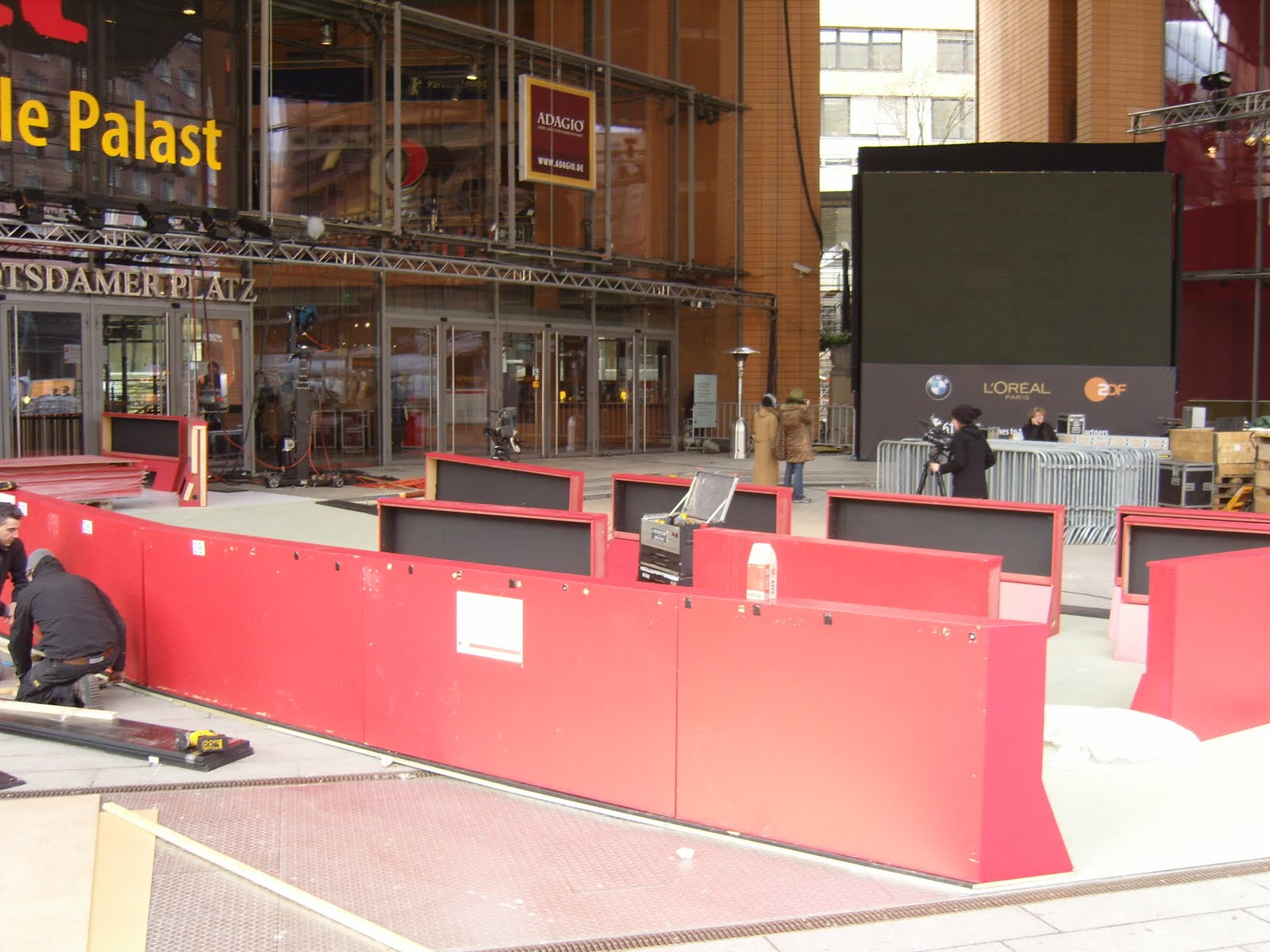
The red carpet including spots and floodlights and some basic heating equipment to keep the stars (moderately) warm, are still being installed outside the Theater on Potsdamer Platz which doubles as the home of the Berlinale for the duration of the festival as it has done for the past nine years:


This year's Berlinale poster as seen on the Boulevard of the Stars on Potsdamer Platz:

The historic Martin Gropius Building, built by Walter Gropius' father, is currently receiving a facelift, though it'll still be home to the European Film Market, as it has been for the past five years ever since its previous location proved too small. Outside, everything appears to be ready to roll with all Berlinale flags and banners already up and waving in the brisk Berlin air. Inside, though, it's a different story as hundreds of craftsmen, handymen and electricians and so on are still busy setting up shop for several hundred film companies from all over the world:


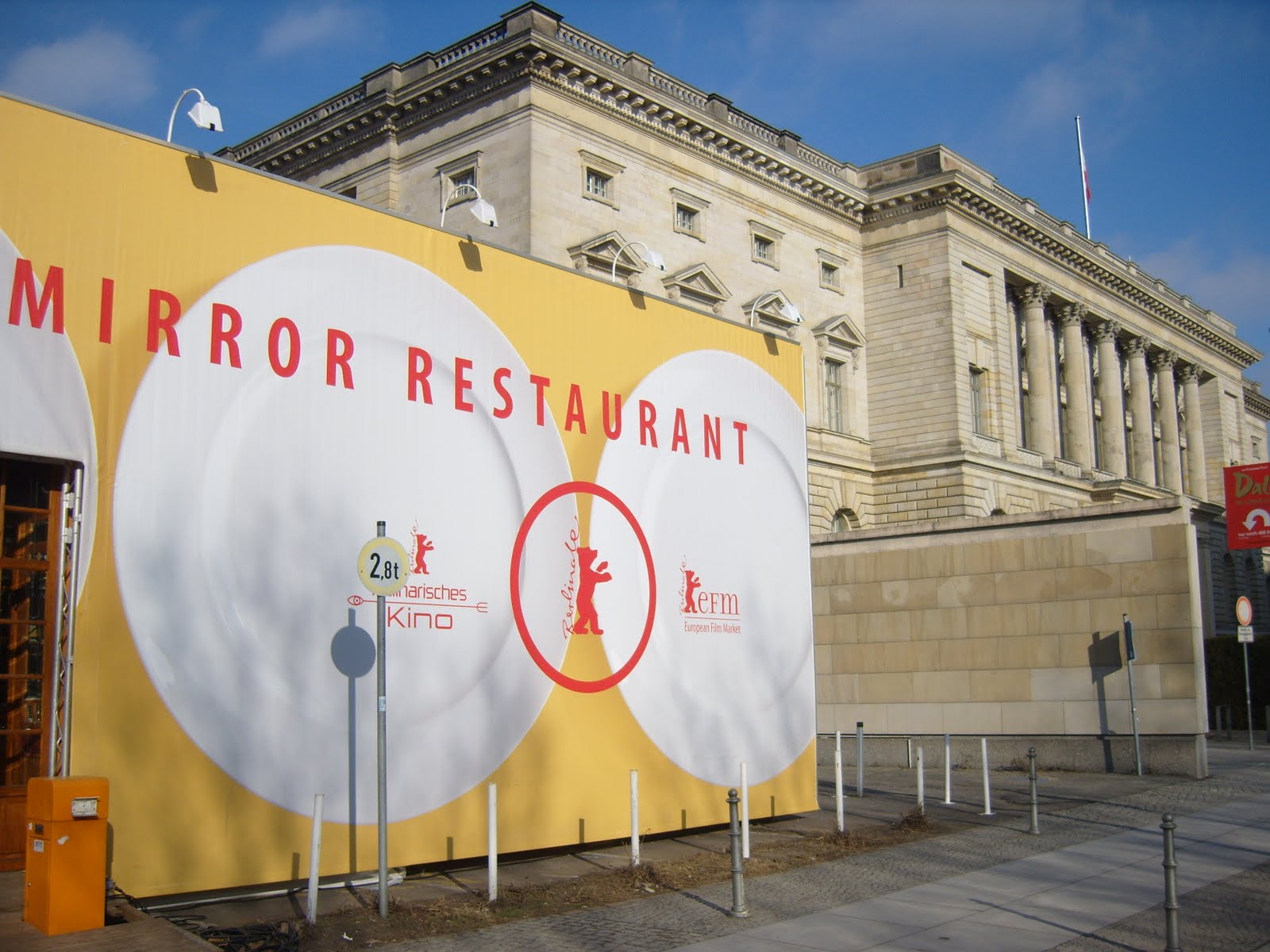
Opposite the European Film Market located in the Martin Gropius Building is the Gropius Mirror Restaurant, a fancy eatery based in a 19th century tent imported from Belgium, set up only for the duration of the film-festival. It is currently receiving the finishing touch in order to look its grandest for tomorrow's opening. The building in the back is the Berlin Senate:


CHECK THIS BLOG FOR REGULAR UPDATES ON THE BERLIN FILM-FESTIVAL!
This year's official Berlinale poster was designed by the Berlin-based Boros agency and is without a doubt the most tasteful poster the festival has had in years. The Boros Agency is owned by Christian Boros who also owns the legendary Boros Collection, a collection of contemporary art, located in a converted bunker from WWII in central Berlin:

Unlike Venice or Cannes - which are Berlin's main competitors - the Berlinale is an audience festival, meaning that not only journalists and people from the film industry are able to attend Berlinale screenings, but ordinary cinema-goers as well, subject to availability of course! It has been reported, that on the first day alone, which was Monday, 32,000 tickets have been sold. Ticket sales were close to half a million at last years festival, a number which is expected to be topped this year. The photo below shows the queue outside one of the ticket booths for advance ticket sales on Potsdamer Platz:

The red carpet including spots and floodlights and some basic heating equipment to keep the stars (moderately) warm, are still being installed outside the Theater on Potsdamer Platz which doubles as the home of the Berlinale for the duration of the festival as it has done for the past nine years:

This year's Berlinale poster as seen on the Boulevard of the Stars on Potsdamer Platz:

The historic Martin Gropius Building, built by Walter Gropius' father, is currently receiving a facelift, though it'll still be home to the European Film Market, as it has been for the past five years ever since its previous location proved too small. Outside, everything appears to be ready to roll with all Berlinale flags and banners already up and waving in the brisk Berlin air. Inside, though, it's a different story as hundreds of craftsmen, handymen and electricians and so on are still busy setting up shop for several hundred film companies from all over the world:


Opposite the European Film Market located in the Martin Gropius Building is the Gropius Mirror Restaurant, a fancy eatery based in a 19th century tent imported from Belgium, set up only for the duration of the film-festival. It is currently receiving the finishing touch in order to look its grandest for tomorrow's opening. The building in the back is the Berlin Senate:


CHECK THIS BLOG FOR REGULAR UPDATES ON THE BERLIN FILM-FESTIVAL!
Subscribe to:
Posts (Atom)