Showing posts with label Los Angeles. Show all posts

Sunday, 18 September 2011

City of Angels: The Studios - The Studio Era, Part 10

Read the last instalment of my series on Hollywood, the studios, and the studio era. For all previous posts on this series, please refer to the archives on the bottom of this page!

If anything, through advantageous and synergic takeovers and mergers like Time/ Warner/ AOL, Viacom/ Paramount, and Sony/ Columbia, the studios, and films in general, even benefited from those new media, at least financially.

As for the quality of the films, I can’t help thinking that although not all that glittered was gold in Hollywood’s golden era, what the moguls brought to their jobs was a proficiency and a profound love for the industry they created. A buccaneer-spirit paired with the vigour and pluck of the pioneers they were.

But the Hollywood of the studio era is irrevocably gone.
And after all, it probably never was much more than one huge, gigantic factory of dreams spread out over various parts of The City of Nets as Otto Friedrich referred to Hollywood in his autobiography.

I for my part, however, choose to think of it as another world, another universe, created by Hollywood’s founding fathers and inhabited by one big, enormous, dysfunctional, royal family, in the form of the big studios, with the moguls as the powerful patriarchs of the family’s various branches.


City of Nets by Otto Friedrich is highly recommended reading for anybody interested in Hollywood's golden age. Though very anecdotal, it is a first hand account by someone who lived and worked in the studios but not on the front lines, but rather in the background. Friedrich was a brilliant observer whose scrutinising eye escaped nothing.

For more books on Hollywood there's no better place than Larry Edmunds legendary bookshop on 6644, Hollywood Boulevard.

Click HERE to visit their website!

Wednesday, 7 September 2011

City of Angels: The Studios - The Studio Era, Part 9


Pauline Kael

The all pervading atmosphere of terror, brought on by the committee’s shenanigans did nothing to nurture what remained of Tinseltown’s creative spirit, which is exactly what Hollywood needed most to win the battle against television and in its struggle to get audiences back to the big screen.

Today, agencies have replaced the big studios, setting up package deals between writer, director, producer and star, who tend to be all under contract to the same agency. Studios are reduced to a mere distributing role, and to letting space to independent producers, who usually consist of the film’s director or star. As an independent production they rent space, or other studio facilities, at a particular studio over a certain amount of time. And even though studios still produce -or co produce- films, the better part of the activity on the lot is dedicated to television.


Francis Ford Coppola


Alan J. Pakula


Martin Scorsese


Hal Ashby

Re-emerging after the sorry years of the 1950s, Hollywood entered a second golden age towards the end of the 1960s, or, to quote famous film critic Pauline Kael, Hollywood’s only golden age. With the Old Guard gone, the Production Code abolished, and the studios mostly run and owned by huge conglomerations, in which the studio itself was but a minor asset, a new herd of film makers entered the scene, who, with their verve and idealism infused Hollywood with a string of remarkable movies. Influenced by the Vietnam War, the rise of Women’s Lib, and a new sexual freedom, film makers like Martin Scorsese, Francis Ford Coppola, Roman Polanski, Woody Allen, William Friedkin, Alan J. Pakula, Robert Altman, Arthur Penn, and Hal Ashby led the way to what would later be dubbed as the New Hollywood, producing films that went beyond mere entertainment, analysing, scrutinising and dissecting human behaviour and society as a whole. Steven Spielberg changed all that.


When his film Jaws (1975) was released nationwide and subsequently breaking all box-office records, the age of the blockbuster was born, as studios and producers realised that given the right product and an adequate marketing and distributing strategy, millions of dollars could be made with just one film. Spielberg, who had astonished cinema goers with two remarkable, off-beat, low-budget films, done well before he entered blockbuster territory , Duel (1971) and Sugarland Express (1974), went on to become commercially the most successful director of all time.

Entering the 1980s, it is interesting to take a look at the Academy Awards, whose significance as indicator for the excellence of films has greatly diminished, but which have assumed the role of a magnifying glass for the zeitgeist: In comparison to the 1970s, where films that won the Best Picture award were commercial as well as critical successes, the 1980s presented a different scenario, as hardly any of the top box-office grossers were awarded the Oscar for Best Picture. In that respect, the 1980s, the business-orientated politics of the Reagan notwithstanding, reflected the Hollywood of the past, where the Academy tended to value quality higher than box-office returns.

But with society changing constantly, and with a world-wide shift towards the political right, accompanied by an ever-increasing hunger for profit and economic growth, during the 1990s grosses took precedence over quality, and the Academy Awards for Best Picture was usually bestowed upon films that were box-office winners, with little or no regard to their artistic merits. Clint Eastwood’s Unforgiven (1993), and Spielberg’s Schindler’s List (1994) being an exception to the rule inasmuch as both works were artistically as well as commercially triumphant.

This trend continues to the very day, and Hollywood today is indeed the factory of films it was thought to have been during the studio era. A lot of money is lavished upon the production of a major studio release, but other than the fact that yet another box-office record was once more broken, the finished result is mostly forgettable. As a reaction to this trend, a new, independent cinema has emerged, producing low budget films with a focus on the story and, luckily, quality, and some studios even set up an independent branch, such as Warner Brothers’ New Line to counterbalance its big budget releases.

Cinema attendance has been soaring for the past twenty years, disproving prophets of doom who, at the onset of the 1950s and the sorry time that followed, predicted the death of cinema and the end of motion pictures. The reverse is true, however. American cinema, after having survived HUAC, successfully battled the onslaught of television, videos, DVD players, and home computers.

Sunday, 28 August 2011

City of Angels: The Studios - The Studio Era, Part 8


John Garfield

The very disappointing stance of the studio heads led to a ten year unofficial blacklist, which was implemented in the most insidious way, as free lance writers stopped receiving assignments from the studios and actors were told that they “were too good for the part”. Blacklisted actresses Anne Revere and Kim Hunter were out of work for years. John Garfield, one of Hollywood’s most outstanding actors, couldn’t get a job because of his steadfast refusal to co-operate with HUAC and to name names. He died under mysterious circumstances in May 1952. Director Abraham Polonsky, whose film, Force of Evil (1948) is now considered a classic, was a victim, and so were Joseph Losey and Charlie Chaplin, who were both forced to leave the Unites States and subsequently settled in Europe. Over 200 film workers were inspected and lost their jobs as a result of the blacklist for their alleged connections to the Communist Party.


Elia Kazan

HUAC’s second wave of investigation in Hollywood took place between 1951 and 1953, this time headed by the infamous Senator Joseph McCarthy. Over a hundred film workers were subpoenaed, Orson Welles, Lucille Ball, Lillian Hellman and Dashiell Hammett, among them. Fifty eight of them gave in to McCarthy’s demands to name names, such as directors Elia Kazan, Robert Rossen, and Edward Dmytryk and even acclaimed writer Budd Schulberg, who would later write On The Waterfront(1954), which, directed by Elia Kazan, was their joint vindication for their decision to fink on their colleagues.

Clifford Odets

Clifford Odets, who had known Kazan during their time at New York’s Group Theatre in the 1930s, also resorted to take the easy way out, naming names and firmly denying his former affiliations with the Communist Party, claiming that he was merely harbouring sympathetic feelings towards the working class. Thus, Odets avoided being blacklisted, and went on working unhindered in Hollywood, unlike many of his colleagues. Although naming names enabled people to continue working, Kazan stated in his autobiography that his decision to rat on his colleagues wasn’t based as much on that, as it was over his aversion towards the Communist Party, of which he had been a member during the 1930s, when he was part of New York’s Group Theatre.

As Katherine Hepburn, a life-long liberal, once said, “I can’t blame anyone for saying things so that he can keep working. But when somebody says things to keep other people from working, he has crossed a line”. The truth was, that some of the blacklisted screen-writers did in fact continue to write. But in order to so they had to work under an assumed name, for their real ones were not supposed to appear on screen. Oscar winning screen writer Howard Koch, for instance, who was blacklisted after writing The Thirteenth Letter (1951), which was a thinly veiled attack on the blacklist, wrote under the pseudonym Peter Howard. This privilege, however, logically, didn’t extend to other professions, least of all acting, as changing their names would have done little to hide their true identity, as their faces would still have been visible on screen.


Dalton Trumbo

Otto Preminger, who was the first one to break free from the shackles of the Production Code, was also a trailblazer when it came to openly hiring blacklisted writers, when he asked Dalton Trumbo in 1959 to write the screenplay for his film Exodus (1960). Preminger, whatever his merits as a film maker may be, was a trailblazer in other ways, too, as he also broke new ground by being one of the first directors to work with an entire black cast for his musical Porgy and Bess (1959), and later, in 1962, being the first Hollywood director to tackle the subject of homosexuality in his film Advise and Consent (1962).

The Communist witch hunt, which befell America in the years after the Second World War, was a dark chapter not only in the history of Hollywood but in the history of the country as a whole, and one that changed the film community forever. The saddest part being, that it brought out the worst - and in a few cases – the best in people, and all over a cause that in a country set out to be the world’s arbiter of democracy should never have been an issue in the first place, for the primary principles of any democracy are freedom of speech and freedom of opinion. Sadder, still, is the fact, that by succumbing to HUAC’s demands and playing by HUAC’s rules, the studio chiefs headed straight for the disaster, which they so desperately wanted to avoid.

>>> check back in next week to learn more about Hollywood and the demise of the studio era!

Monday, 22 August 2011

City of Angels: The Studios - The Studio Era, Part 7, Witch-Hunt In Hollywood

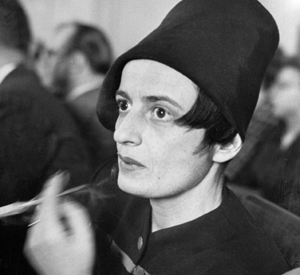
Among the friendly witnesses called up to testify were Gary Cooper, Jack Warner and novelist Ayn Rand, who was Russian by birth, but who had moved to the US in 1926, and whose subsequent commercial success as a writer turned her into a staunch anti-Communist, leading her to heavily attack MGM’s film Song of Russia (1944), which was in fact nothing but a harmless romance between an American soldier and a Russian peasant girl. Song of Russia was filmed in the light of the two countries’ short lived alliance in their war against Nazi Germany, which had prompted President Roosevelt to encourage the studios to paint a somewhat friendlier picture of Russia to make Americans feel more at ease with their erstwhile enemy-turned ally.


Ayn Rand

The studio heads, always willing to comply with the Government’s requests, produced a number of pictures between 1943 and 1945 that were indeed pro-Russian, such as Mission to Moscow (1943), The North Star (1943), and Tender Comrade (1943) as well as the abovementioned Song Of Russia. Little did they know, however, that once the war was over, they would find themselves under attack for something they merely did at the Government’s instigation.


MGM’s Louis B. Mayer himself was summoned before the Committee to justify the making of Song Of Russia, which was deemed Communist propaganda by the Committee, a view ardently shared by Ayn Rand. Ronald Reagan, once a member of the Democratic Party, was also asked to testify in his position as President of the Screen Actors Guild. His disgust with Communism made him one of HUAC’s keenest supporters, and subsequently turned him into a Republican.

Of the nineteen unfriendly witnesses, eleven were called up to take the stand. However, only one of them, the German playwright Bertolt Brecht, did. Making a brief appearance before the Committee, during which he denied all ties to the Communist Party, he boarded a plane back to Europe shortly after and based himself in East Berlin, where he went on to become the pride and joy of East Germany’s Communist Government. The remaining ten (writers Alvah Bessie, Dalton Trumbo, Samuel Orvitz, Herbert Biberman, Lester Cole, Adrian Scott, John Howard Lawson, Ring Lardner Jr., Albert Maltz, and director Edward Dmytryk) refused to testify and claimed their Fifth Amendment Rights. They were held in contempt and had to serve prison terms between six and eight months. Their studio contracts were suspended, and after being released from prison they found themselves blacklisted.

Herbert Biberman


Ring Lardner


Alvah Bessie


Edward Dmytryk


Bertolt Brecht


Dalton Trumbo


John Howard Lawson

Alarmed by the Committee’s findings, and fearful of the damage it could do to Hollywood’s reputation, not to mention the already unstable box-office returns, all studio heads and some executives gathered in New York’s Waldorf Astoria Hotel on November 24, 1947, to discuss the situation and think about a unified response. The following statement was released to the press:

“We will not knowingly employ a Communist or a member of any party or group which advocates the overthrow of the Government of the United States by force, or by any illegal or unconstitutional method”.

Read today, the moguls’ response seems ridiculous and unfathomable. Yet, the hysterical fear of Communism led to a fanatical witch hunt which made red baiting the new National Religion.

To read more on HUAC and the witch-hunt in Hollywood, log on again to FILM-TALK this Saturday!

Saturday, 13 August 2011

City of Angels: The Studios - The Studio Era, Part 6


Trust Hitchcock to find his own way of getting around the two second restriction that the code put upon a kiss by having Cary Grant and Ingrid Bergman briefly interrupting their endless kissing scene in Notorious (1945) after every two seconds.

Otto Preminger

It would take the hard-headedness of an Otto Preminger to defy the restrictive rules of the code in 1954 with his film The Moon is Blue, in which he dared showing an ex-marital couple living under the same roof - which is something that was still strictly verboten. United Artists, the film’s distributor, decided to release the film without the production seal, thus setting a trend that gradually spilled over to other directors and studios. But after Preminger’s film proved to be a major box-office hit, studios had to face the fact that with the onslaught of television, and cinema attendance in rapid decline, the general public expected to be shown something that the family orientated TV didn’t yet provide. The result was an increasing disregard of the Production Code, until it eventually became obsolete altogether. It wasn’t until the mid-1960s, however, that the Production Code entirely lost its impact and control over American film, to be replaced by a rating system, modelled on that of Great Britain.

1950 marked the end of the studio era and Hollywood’s golden age, and the beginning of the free-wheeling age, where independent producers and agents called the shots. The film moguls who had ruled the studios for three decades had grown old, had to face the fact that their own studios had outgrown them. They withdrew from the film industry, and in some cases were even forced into retirement, like Louis B. Meyer. The ones who stayed put, like Jack Warner, who was the last one of the first generation’s moguls to step down in 1967, were simply overwhelmed by the turning tides, and found it difficult to keep up with the ever more unpredictable tastes of the fickle public.

Jack Warner

1947 saw the dawn of television, which by 1950 had become a veritable threat to the big screen, resulting in slipping cinema attendance, which the studios, already weakened by the Government’s Consent Decree, forcing them to divest themselves of their theatre chains, found difficult to stomach. The vertical integration of production, distribution and exhibition, in which Paramount’s Adolph Zukor once pioneered, was ruled illegal by the government by setting up strict anti-trust laws, which led to the disintegration of the studio system. Studios like Columbia, that didn’t own any theatres, had an easier time, as the Government’s ruling obviously didn’t affect them.

In addition to Hollywood’s considerable travails, the House Committee of Un-American Activities (HUAC) had started its hearings in Hollywood in 1947 and resumed them in 1951, sending shock waves through the film community, and the resulting atmosphere of fear that descended over Hollywood was a death knell to what it most needed to survive: art and creativity. As it turned out, the HUAC hearings were akin to the kiss of death of the already battered film industry. Founded in 1938, HUAC’s aim was to investigate all areas in American society with public exposure for their possible ties to Communism and the Communist party. Needless to say, the film industry with their millions of viewers posed an obvious target for HUAC. HUAC’s fervour cooled down during the Second World War when Russia and America became temporary allies in their war against Nazi Germany, only to resurge after 1945, which, with the world map once more reshuffled, marked the beginning of the Cold War, subsequently turning Russia from ally to enemy.

J. Parnell Thomas

HUAC, headed by J. Parnell Thomas, began its hearings in October 1947, probing the film community’s involvement with Communism and Hollywood’s possibility to insert Communist propaganda into its films. HUAC polarised Hollywood, splitting it in two – the right wing, conservative circle around Robert Taylor, Cecil B. DeMille, John Wayne, Adolphe Menjou, Ginger Rogers, and Sam Wood, who avidly supported its doings and purpose, and the liberal, left wing group around John Huston, Humphrey Bogart and his wife Lauren Bacall, John Garfield, William Wyler and Myrna Loy. Consequently, when HUAC picked certain film workers to take the stand, the field was divided in friendly witnesses, who were willing to co-operate with HUAC’s requests, and unfriendly ones, who refused.


Read more on HUAC and its impact on Hollywood next week!

Monday, 8 August 2011

City of Angels: The Studio Era, Part 5

However, there were others, directors who established a very close bond with their respective writers with whom they worked hand in glove, such as John Ford with Dudley Nichols or Frank Capra with Robert Riskin. Their repeated collaboration resulted in profoundly personal films which unmistakably bore the director’s trademark.

Orson Welles

And there were those like Orson Welles, who had never been anything but an auteur, for he produced, wrote, directed and even starred in his own films from the moment he set foot on Hollywood. Therefore, strictly speaking Alfred Hitchcock, who had a tendency to change his writers from project to project, didn’t really fall into the auteur bracket. Yet, since he possessed the rare gift of visualising the finished film long before the writer got a chance to take down even a single word, it was he who greatly influenced the screenwriter, steering him in such a way that left the writer little room for manoeuvre. Thus, in François Truffaut’s eyes Hitchcock was the epitome of the auteur, the quintessential director-cum-artist, who managed to turn his obsessions and visions into a work of art.

Ida Lupino

The profession of a film director in Hollywood -as much as elsewhere- was still pretty much a man’s prerogative. But two women broke that tradition, successfully asserting themselves in a world dominated by men. One was Dorothy Arzner, who had been under contract to Paramount between 1927 and 1932, but worked independently afterwards, and who is best known today for her film Christopher Strong(1933), done at RKO, in which she directed a young and aspiring Katherine Hepburn. Some years later, Ida Lupino followed her footsteps. Starting out as an actress at Warner’s where she was unflatteringly nicknamed “the poor man’s Bette Davis”, reflecting the unsatisfactory assignments she was given which, more often than not, were handed-down roles Davis had rejected. Arguably her best film as an actress was in Raoul Walsh’s atmospheric and sinister High Sierra (1941), where she played alongside Humphrey Bogart. Her assignments failing to improve, together with her husband she founded their own production company, aptly called The Filmmakers, and Ida went on to blaze new trails by becoming one of the most respected B-movie directors, and the second woman in Hollywood history to be admitted to the Directors Guild of America. Her modestly budgeted films had a tendency to deal with -at the time- controversial subjects, such as rape (Outrage, 1950) and bigamy (The Bigamist, 1953), which the restrictions imposed by the Production Code made difficult to tackle on screen. In a pun to her earlier nickname, Lupino jokingly referred to herself as “the poor man’s Don Siegel”. She continued to appear in front of the screen, albeit sporadically, and among her most notable assignments as an actress during the 1950s are Nicholas Ray’s On Dangerous Ground (1951), which included a meaty part for her playing a blind woman, and Jack Palance’s wife in the film adaptation of Clifford Odets’ corrosive take on Hollywood, The Big Knife (1955), directed by Robert Aldrich.

Will Hays

The Hollywood of the studio era was really a time when a director who wanted to express anything to do with sex, morals and gender found himself on slippery ground.
A certain artistic genius was indeed required to get around the censors and to widen the narrow margin the Hays Code imposed upon the film makers and screenwriters.
Although the Hays Code was officially introduced in 1934, Will Hays had been the spokesman for the Motion Picture Producers and Distributors Association since 1922, when the former Postmaster General was summoned to Hollywood to represent the studios to the outside world. His job was Hollywood’s answer to a public outcry following a number of scandals -notably the Fatty Arbuckle rape case- which shook the fledgling film community in the early 1920, making it vulnerable to criticism and attacks by the press as well as various religious organisations. However, by 1930 first steps were taken by Hays to set up a code that would regulate and determine what could be shown on screen, and by 1934, the Production Code -or Hays Code, as it is usually referred to- became operational with Joseph Breen as director.

The Production Code was also supposed to exclude violence from the screens, and “to use popular entertainment films to reinforce conservative moral and political values”, which to some extent, was like a prelude to the events that later wreaked havoc in Hollywood, when the House Committee of Un-American Activities (HUAC) started investigating the film community for possible Communist infiltrations, as the Production strictly forbade any depiction of radical or socially critical behaviour.
The code stipulated that every screenplay had to be submitted to the Breen Office for approval. And without Breen’s seal and blessing, sending a script into production was pointless for if the Breen office deemed the contents morally offensive, it would have been impossible to release the finished product. It was not by accident that Mae West’s films after 1934 were harmless, almost bloodless, comedies that lacked the bite and vigour of her previous efforts (I’m No Angel, She Done Him Wrong, both 1933), whose innuendo and double entendre would have never found the approval of the Joseph Breen.

Mae West

The Production Code didn’t tolerate any mention of homosexuality, nor unmarried couples living together. And a woman, who even to the most clueless viewer couldn’t be anything but a hooker, became a ‘woman of leisure’ or, at best, a showgirl, as no allusions whatsoever could be dropped to the woman’s true profession. Double Indemnity (1944), Wilder’s masterpiece based on James M. Cain’s novel, was considered un-filmable for years because of its subject which was deemed debauched and depraved. That it found Breen’s approval -and its way to the screen- is due to the genius of Wilder and his collaborator Raymond Chandler, who both managed to find a way of expressing everything by saying and showing nothing.

Thus, subtlety became an art-from in itself.

And, I’m inclined to add, Hollywood, became all the richer for it, for certain directors like Berlin-import Ernst Lubitsch, whose skill and finesse made him Hollywood’s uncrowned king of innuendo, seemed to bloom and flourish when it came to beating the code at its own game and turning the code’s confinement to his advantage.

Ernst Lubitsch


This series continues on Saturday! Be sure to be back!

Sunday, 31 July 2011

City of Angels: The Studio Era, Part 4


Nathaniel West

To stock up on talented writers, studio executives started raiding New York’s Broadway and the publishing industry, and lured by Hollywood’s tempting salaries -which far exceeded Broadway’s - the writers came in droves. The Hollywood of the 1930s and 40s reads like the Who’s Who in American literature, as virtually every major American novelist passed through Hollywood at some point, having been snatched up by one of the major studios: F.Scott Fitzgerald, Nathaniel West, John Steinbeck, William Faulkner, Aldous Huxley, Raymond Chandler, Clifford Odets, Budd Schulberg, among many others, all tried their hand at screenplays, some of them being more successful at it than others. However, only a few among them ever took to Hollywood. Most of them despised the town, deploring its lack of high culture as well the working conditions. These working conditions notwithstanding, being a so-called studio slave inspired some writers to turn their experiences and observations in Tinseltown into their best work.

Budd Schulberg

Nathaniel West’s scathing The Day of the Locust paints a dark picture of Hollywood’s gold-digger years, while Budd Schulberg’s gripping What Makes Sammy Run tells the story of a fast and furious parvenu with a fire in his head, determined to become a big-time Hollywood producer whose burning ambition is a direct result of him having been born into an impoverished Jewish family living in New York’s Lower East Side. Like the majority of the moguls, the book’s hero - Sammy Glick - also wants to keep his Jewish origins under wraps, changing his name from Glickstein to Glick as he's assimilated to the point where his Jewish heritage is all but erased.

Jerry Wald

Ever since Schulberg’s novel was first published in 1941, it has been widely known that Sammy Glick’s character is but a thinly veiled portrayal of a real-life Hollywood personality and rumour has it that Jerry Wald, the producer of Key Largo (1947) and The Best of Everything (1959) was in fact the model for Schulberg’s hero. Schulberg himself was born into one of Hollywood’s foremost families, and consequently he knew the film business inside out even before he started out as screenwriter himself, his father, B.P. Schulberg, having been the head of Paramount for a short period during the 1920/ 30s.

Raymond Chandler

Although Raymond Chandler never wrote a book about Hollywood other than an essay, titled Oscar Night in Hollywood, published in Atlantic Monthly in 1948, Chandler's hard-boiled crime novels struck a chord with war audiences, resulting in a contract with Paramount for which he wrote a couple of screenplays which stood at the centre of what eventually became known as Film Noir.
Having lived and worked in Los Angeles for the better part of his life, when Raymond Chandler followed Hollywood’s call he was already well into his fifties. Akin to his fellow writers he found it difficult to adapt to life in the film community and as a result, he had frequent run-ins with his directors.

Film Noir, "where the streets are dark with something darker than night" (Raymond Chandler)

The term Film Noir originated with a number of young French film enthusiasts during the mid 1940s who were in the process of rediscovering and reevaluating the Hollywood films of the war years, namely the long list of thrillers and crime movies which, drenched in darkness and perfidy, reflected the disquieting effect the war had on America.

Some time later, French directors Francois Truffaut and Jean-Luc Godard would become very influential in establishing the Nouvelle Vague, which injected new life into the French film industry. Their admiration for American Cinema was boundless, for they saw and read meanings into those films that so far had been invisible to the ordinary cinema-goer. It surely is no exaggeration saying, that had it not been for people like Louis Malle, François Truffaut, Jean-Luc Godard, André Bazin, and Claude Chabrol, film criticism would be the poorer for it, for even though they all eventually became directors in their own right, they were conducive in the foundation of Cahiers du Cinéma, a periodical which unlike the better part of most film magazines around today, doesn’t resemble a publicity pamphlet from a film studio.
It all culminated, of course, in Truffaut’s book about Alfred Hitchcock, How Did You Do It, which has become a milestone in film theory.

Francois Truffaut

After Hitler’s rise to power in January 1933, Hollywood’s impressive stable of writers was joined by an ever increasing number of film working immigrants from Europe - many of whom writers - who began arriving in Hollywood following the Nazi-takeover, thus adding to Hollywood’s already well established list of ex-patriots, like Marlene Dietrich, Ernst Lubitsch, Maurice Chevalier, Bertolt and Salka Viertel, Greta Garbo, Wilhelm and Charlotte Dieterle, and many others. Aided by the European Film Fund, writers like Bertolt Brecht, Alfred Doeblin, Heinrich Mann, and Walter Mehring, all ended up getting a job in Hollywood’s film industry, but found it wearisome to adjust not only to the working methods, but also to having to write in a foreign language of which most of them had little knowledge.

Bertolt Brecht

Billy Wilder on the other hand, who also spoke hardly any English upon his arrival in the US in 1934, wound up with a command of the English language which far exceeded that of his compatriots, enabling him to turn into a full-fledged screenwriter, and in time, director, thus joining a select group of talented film workers who made the successful yet difficult transition from writer to director: Preston Sturges, John Huston and Joseph L. Mankiewicz, also were among them. A writer-turned-director would later be dubbed auteur by the same group of French film enthusiasts who were also responsible for the re-discovery of the films which they classified as Noir.

This series continues next week!

Sunday, 24 July 2011

City of Angels: The Studio Era, Part 3

In 1913, the Jesse Lasky Feature Play Company, which included Lasky himself, Cecil B. DeMille, and Samuel Goldwyn, reached Hollywood by way of Flagstaff/ Arizona, to shoot The Squaw Man. The film has since been remade twice and on both occasions by DeMille himself. It is the filming of The Squaw Man more than anything else that we have come to associate with the dawn of Hollywood as the world’s Mecca of Film. But this, as we've seen, is not entirely true for there were a large number of film pioneers who beat Mr. DeMille to being the first filmmaker to discover Hollywood’s merits as a film location. The Squaw Man, however, was the first-ever feature film (= four reels or more) to be shot in Hollywood. Other feature films of that period such as Griffith’s Judith of Bethulia (1913) having been shot in the San Fernando Valley while Adoph Zukor’s trailblazing Queen Elizabeth (1912), starring legendary actress Sarah Bernhard, was shot way back in New York!

The Lasky-DeMille barn, now the Hollywood Heritage Museum, located on 2100 North Highland Avenue in Hollywood

Initially bound for Flagstaff, in order to escape the Trust as well as New York’s whimsical weather conditions, they quickly made up their mind that the dry, deserted, flats of Arizona wouldn’t do and headed straight to California. To shoot their film, DeMille and his peers rented the barn of a German settler, Jakob Stern, located at the corner of what is known today as Selma and Vine, just a stone’s throw away from bustling Hollywood Boulevard, or rather, Prospect Avenue, as it was called then. The now legendary Lasky-DeMille barn is still standing, although not on its original location. Having been moved to its new site across from the Hollywood Bowl, the Washington Mutual Bank now occupies the barn’s former ground. In deference to Hollywood’s film pioneers and their film, The Squaw Man, the bank’s entire façade has been tiled in a mosaic that depicts various scenes from the landmark film that was shot there nearly a hundred years ago.

In 1916 the Lasky Feature Play Company merged with Adolph Zukor’s Famous Players to form Famous Players Lasky, with Zukor as president, Lasky as vice president, Goldwyn as chairman, and DeMille as director-general. But, as Zukor’s biographer Will Irwin, puts it, “even this large company was too small, however, long to include four such able and positive characters”, and before long Goldwyn sold out to his partners and merged with Edgar Selwyn to found the Goldwyn Company, which eventually was fused into Metro-Goldwyn-Mayer in 1924. Goldwyn, obviously a free spirit, soon dropped out from the company that would thereafter bear his name to become the most charismatic of Hollywood’s independent producers. Zukor on the other hand, slyly merged his Famous Players Lasky Company with Hodkinson’s distribution company called Paramount, thus pioneering in the vertical integration of production, exhibition and distribution, a concept that would later be adopted by most other Hollywood studios.
As a name for his giant corporation Zukor opted for Paramount, which swiftly turned into the most influential and most powerful motion picture company, a position it held until the formation of MGM in 1924.

Things were developing at rapid speed when in 1915 William Fox founded his Fox Film Corporation, and took over the Selig studios in Edendale in 1916, joined by Louis B. Mayer in 1918, who became Selig’s tenant for a while, before building his own studio on Mission Road a year later. Metro rented its first studios in Hollywood in 1916, but was acquired by the cunning Marcus Loew in 1920, who four years later orchestrated the deal between Metro, Mayer, and Goldwyn, with himself as president, which led to the foundation of MGM, which in time, became almost a synonym for Hollywood itself.

Barbara Stanwyck, dressed by Edith Head, in Wilder's Double Indemnity (1944)

Film scholars generally name 1923/ 24 as the juncture the studio era began. All major studios were in place, except RKO, which joined the ranks of the majors a few years later- and literally all major studios followed the same pattern: the vertical integration of production, distribution and exhibition, which means that films were produced on the studio’s lot, distributed by the company’s distribution arm, and largely shown in cinemas owned by each respective studio. Not all studios were equally strong in each division, with some studios possessing a cinema chain smaller than that of other studios, while others had back lots and production facilities that were far superior to that of a rival studio.

Hedda Hopper, who wittily titled her autobiography From Under My Hat


Louella Parsons

In addition to that, all talent -from actors, directors, producers, to cameramen, set-designers, costume-designers and technical staff- was under contract to the studio. Again, not all studios equalled each other in their employment practices. Columbia, for instance, had scant talent under contract to the studio, and operated mostly by borrowing actors from other studios. A common practice, as it enabled the lending studio to, either make money on a contract player for whom no suitable project could be found. Or, in many cases, even a profit, as the asking price usually far exceeded the star’s salary, or else, punish a star who had gotten too big for his breeches by sending them off to a minor studio. Besides actors who were under contract to a studio, there were also a number of free-lancers like Cary Grant or Barbara Stanwyck. But free-lancing didn’t really become common procedure until the decline of the studio system gave rise to the more free-wheeling methods of the 1950s and 60s, when deals were struck between a studio, an independent producer like, for instance, Sam Spiegel, and a cast of bankable actors.

Travis Banton

Even though a lot of actors complained -and some famously even sued their studios for what they considered malpractice- to be under contract to a studio was in fact a blessing in disguise, as it meant steady work with a regular salary under the protection and guidance of a big studio whose aim it was to build up a face into a name and, eventually, into a star. Still, glorifying the contract system would be as wrong as flatly condemning it. Truth is, that it was a double-edged sword, since protection and a steady flow of work was only guaranteed as long as the star’s pictures continued to make money. While the duration of the contract was usually seven years -for that was the time the studios deemed necessary to build up a star-, the commitment on the studio’s side was only six months. This meant that a star, tied to a studio by a standard seven-year-contract, could be dropped by a studio with only six months notice.

Also, building up a star included complying with the demands of the studio’s publicity department, which could include anything from having your teeth fixed or your hair dyed to changing your name and completely reinventing your background. In order to get a young, promising actress’s name into the papers, the publicity department often saw to it that she would occasionally be escorted by one of the studio’s top-ranking male stars to a movie premiere, some lavish party, or even the Academy Award ceremony, thus also fostering the possibility of a romance between two contract actors, which was deemed very advantageous for the studio.

Dietrich - in Sternberg's extravaganza The Devil Is A Woman (1935)

Romances between actors -and the break-ups thereof- were the territory of gossip columnists Louella Parsons and Hedda Hopper. Feared for their sharp tongue and poison pen, they were among Hollywood’s most weighty figures as their columns - Parson’s in Hearst’s Los Angeles Examiner and Hopper’s in the L.A. Times, and both columns syndicated in newspapers all across the U.S. - were read by millions of eager readers every day, and their word had the power to make or break a career.

With the stars at the mercy of two gossip columnists, the studios’ respective publicity departments implored their stable of actors to comply with the columnists’ every request and demand, something which was next to impossible, for trying to satisfy the hunger for news of one, automatically entailed falling out of the other one’s favour, for the simple reason that both columnists were arch rivals, and getting the story first first was what it was all about. Tell It To Louella, is the adequately named title of Parsons’ second volume of her autobiography, published in 1961. Rumour has it, that the ties between Parsons and her boss, William Randolph Hearst, were closer than one might think, for she is said to have witnessed the notorious shooting, involving Thomas Ince, Hearst and his mistress Marion Davies, during which Ince was fatally injured, and to silence her, the newspaper magnate offered her a life-long position at the Los Angeles Examiner, one of his many publications. Parsons was unrivalled in her station as the queen of gossip, until in 1937 Hedda Hopper decided to hang her acting career and throw her fancy hat into the gossip-ring.

Legendary Edith Head whose influence on fashion was as as far-reaching as Paris

In spite of their rivalry, both women had more in common than they cared to admit. Equally relentless when it came to squeezing out the gossip out of their victims, both also held extremely conservative convictions, about which they made no bones, and which rose to the surface during the red baiting, with both vigorously supporting the House Committee of Un-American Activities(HUAC). Both loyal employees, Parsons’ flagrantly slandered Orson Welles’ Citizen Kane(1941) for its thinly veiled portrayal of her boss, William Randolph Hearst. Hedda Hopper, whose dim career as an actress had ended after she started working for the L.A. Examiner, was offered a bit part in Billy Wilder’s landmark Sunset Boulevard (1950), in which she plays herself, wearing one of the flamboyant hats that became her trademark.

In the case of directors, being under contract to a studio could be particularly frustrating as their individual influence varied from studio to studio. Some studios like MGM, or Warner’s under Darryl F. Zanuck, were very producer orientated, leaving the director with little or no say over the finished product. Others, like Columbia or RKO, gave their directors a fair amount of freedom, relying on their vision and skill to come up with a film that was both beautifully crafted yet also successful at the box-office. It goes without saying that a visionary, strong willed producer can be as important to a film as a visionary, strong willed director, and as both positions were generally filled with in-house staff, it was in the studio’s interest to ensure their compatibility.

Bette Davis wearing one of Head's typical gowns of understated elegance in All About Eve (1950)

Like producers, directors and actors, costume designers and set designers, too, were a vital part of the intrinsically woven studio net. They substantially contributed to giving the studio’s output its distinctive look. To recreate a certain period, they had large research libraries at their disposal as well as a prop department, where furniture and interior decorations from all eras and countries were available to them. Most noteworthy among the set designers was Cedric Gibbons, who in his position as MGM’s head of the art department, supervised all releases, and no product would reach the screen without his approval. He was responsible for giving MGM’s films its glossy, luxurious finish, making them easily identifiable, even to the casual viewer, as an MGM product. Gibbons famously also designed the Academy Award statuette, known as Oscar, when his boss, Louis B. Mayer, together with 35 other dignitaries from the film community, founded the Academy of Motion Picture Arts and Sciences in 1927, as a response to the growing power of the unions.

Art directors Lyle Wheeler at Fox, and Hans Dreier at Paramount, both held equally powerful positions as Gibbons, but in neither studio was the emphasis on a film’s look as high as it was at MGM. Gibbons’ sumptuous sets were highlighted by the extravagant gowns MGM’s chief costume designer, Adrian created for in-house stars like Greta Garbo, Jean Harlow and Joan Crawford. Orry Kelly had a similar role at Warner Brothers, being responsible for Bette Davis’ wardrobe during her Warner Brothers period.

Grace Kelly in Hitchcock's Rear Window (1953)

Paramount, however, was home to two of Hollywood’s most outstanding costume designers: Travis Banton was responsible for creating Marlene Dietrich’s extravagant costumes in the films she made for her mentor, Josef von Sternberg, most memorable among them, The Devil is a Woman (1935), in which Banton turned Dietrich into a sequined siren, replete with towering mantillas and veils. The young woman Banton had taken under his wing would later become the most celebrated costume designers of them all: Edith Head. Her trademark of pure, understated elegance would eventually earn her eight Oscars and thirty-four nominations. She went on to dress Bette Davis in All About Eve (1950), Stanwyck in Double Indemnity (1944), and Grace Kelly in Rear Window (1953), to name only three.

Just like all other divisions, writers had their own building, working in tiny, adjoining, offices, expected to churn out stories, rewrite scripts, or add dialogue to an already finished screenplay. At times, more than one writer was assigned to the same project. The position of a screenwriter gained considerably in importance with the advent of sound, as the studios were in dire need of well-crafted stories, spiced up with meaty dialogue.


This series will continue next week, Wednesday. For previous blog entries on Hollywood and Hollywood history, please visit the archives at the bottom of this page!

Friday, 8 July 2011

City of Angels: The Studio Era, Part 1


Films arrived in Southern California in 1907.

The completion of the Santa Fe railway in 1885 triggered a massive land boom within the Los Angeles area, and was fuelled by the subsequent discovery of oil wells, all of which had already begun to alter the nervous system of the prospering city prior to the arrival of the first film folk.

There can be little doubt, however, that the Pacific metropolis wouldn't be what it is today without its film industry.

The studio era officially began in 1923/ 24, a time that marks the formation of Metro-Goldwyn-Mayer, Columbia, Warner Brothers, and the arrival of Joseph Schenk at United Artists. During its heyday, the Hollywood studios were divided into majors and minors. The so-called Big Five were MGM, Warner Brothers, Paramount, Twentieth Century Fox, and RKO, the latter of which joined the ranks of the majors with the advent of sound. The three minors consisted of Columbia, Universal, and United Artists. One of the things all studios had in common is the fact that the corporate power was divided between the money boys in New York and the moguls who presided over the studios in Los Angeles. Not only was New York America’s, if not the world’s, financial hub as much back then as it is now, but before the centre of movie-making shifted from the East Coast to the West Coast, most of the companies were based in New York.

On the fringes there were a number of others, also-rans, like Republic, Eagle Lion and Monogram, film companies which operated on a much smaller scale, cranked out B-pictures, and whose company history was in many cases even more bumpy than that of their bigger brothers and sisters. In the pool of majors and minors, almost each studio had its own specific handwriting, serving as a signature or stamp, which made it relatively easy to identify a film’s birthplace.

MGM, with its impressive line-up of skilled technicians, its awe-inspiring roster of stars, and its charismatic production chief, Irving G.Thalberg, quickly established itself as the glamour studio and the proverbial dream factory, while Warner’s toiled mainly on the dark and gloomy side of the street, focusing on jailbirds, crooks, and gangster molls.

Fox, under the tutelage of Darryl F. Zanuck, for many years lacked a specific look other than being the studio of Sonia Henie and Shirley Temple, until later Zanuck acquired a certain reputation for producing message pictures. Columbia, with a tiny roster of stars, operating on a single block, and the miserly Harry Cohn at the helm, was simply known as the black hole of Calcutta, until, of course, the tremendous success of Frank Capra’s films changed all that.

Universal, besides being the home of Deanna Durbin, whose musicals saved the studio from ruin during the 1930s, also made a name for itself as the studio of horror movies. Paramount, referred to as the country-club of studios, had a wide range of European talent under its roof, and became known as the studio with the continental sheen.

Apart from the big dream factories, Hollywood also hosted a number of independent producers like David O. Selznick, Samuel Goldwyn and Orson Welles Mercury Productions. United Artists, RKO, and Columbia would all become havens for independent producers. Lacking sufficient resident talent to keep their operations going, they rented out their facilities to independents, and often co-produced and distributed their films. With the onslaught of television, which arrived in tandem with the Hollywood witch hunt and the Government Consent Decree that forced the studios to divest themselves of their theatre chains, all of which spelling the end of the studio era, independent productions became the norm in Hollywood. As Billy Wilder once observed, “In the olden days you went to see an MGM picture. It had its own handwriting. Or you knew it was a Warner Bros.picture – Cagney and Bogart and the small actors that were under contract there. Now studios are nothing but the Ramada Inn – you rent space there, you shoot, and out you go”. Billy Wilder chose to ignore the fact that independent productions were precisely what -rightfully- made him the rich man he eventually became.

Billy Wilder

After the studio system had become dust, Hollywood was up for grabs as independent producers were calling the shots, striking up deals between director, studio, actors and writers, each of whom was entitled to their share of the cake, whereas during the studio era, it was the studio that reaped the profits of other people’s labour, but it also shouldered the potential risks. Looking at Hollywood’s output today, it stands to reason that the quality of the films during the studio era was superior, and that today’s free-for-all atmosphere has turned Hollywood into a very shallow gold-mine. Not that all that glittered was gold, of course. And yet, it seems to me that every so often art was being produced not in spite, but because of the studio system. Outside the mogul’s genuine interest in film and their willingness to take risks, with an annual average of forty to fifty releases per studio, they could afford a few box-office duds without losing too much sleep over it. Besides, everybody involved in a film was usually under contract to the studio, which greatly minimised a film’s cost. The studio system’s finely wrought mesh of rules, regulations and restrictions were a safety net as well as a cobweb from time to time.

D.W. Griffith

Above all, the story of Hollywood and its studios is a story of immigration, and thus reflects the story of America itself, as a fact virtually all moguls had in common was, even though they chose to play it down, that they were all first or second generation Jewish immigrants from Eastern Europe, with the exception of Twentieth Century Fox’s Darryl F. Zanuck and the founders of United Artists: Pickford, Fairbanks, Griffith, and Chaplin.

Darryl F. Zanuck


The Tsar of all moguls, MGM’s Louis B. Mayer, was born in Russia in 1885, but left his native village of Demre a mere three years later to settle in the US by way of Nova Scotia. He started his career by working in his father’s scrap iron business before selling tickets at a Boston cinema, and buying his own movie theatre as early as 1907.

Paramount’s Adolph Zukor, born in Ricse, Hungary, arrived in the US in 1888, and started working in the fur trade before investing in a penny arcade in 1904.

Coming from the Polish village of Krasnashiltz, the Warner family emigrated to the United States 1882, settling first in Baltimore, were the four Warner brothers eked out a living by doing menial work ranging from shining shoes and selling soap to cobbling. In 1904 Sam Warner opened up a nickelodeon in Youngstown, Ohio. Joined by his brothers, they eventually ran a larger cinema, until they gradually expanded into distribution.


Samuel Goldwyn

Also born in Poland, Schmuel Gelbfisz grew up in a Warsaw ghetto. At the age of twenty, in 1899, by way of Hamburg, London, Birmingham and Liverpool, he arrived in New York, where, changing his name to Samuel Goldwyn, he began working as a gloves salesman. Later, he got married to Blanche Lasky, the sister of film pioneer Jesse Lasky, with whom we would eventually go into business. In the eyes of Katherine Hepburn, Goldwyn was “the most compelling and colourful of all the movie moguls”. And, she added, “of all those pirates, and they were all pirates, he was the only one with a sense of humour”.

Goldwyn went on to enchant and amuse Hollywood with what was dubbed Goldwynisms, which were largely the result of his struggle with the English language. Not only did he refer to Miss Brontë’s classic as "Withering Heights”, when he was about to acquire the film rights to Lilian Hellmann’s The Little Foxes, he was cautioned by Edwin Knopf that "it is a very caustic play", prompting Goldwyn to reply, “I don’t care how much it costs. Buy it!”. In fact, Goldwynisms have become classics just like most of his films. When showing a painting he recently purchased to one of his friends, he proudly announced that this was his “new Toujours Lautrec”. During the House Committee of Un-American Activities(HUAC) hearings, Goldwyn was the only one of Hollywood’s producers to speak up against its activities, releasing a press statement that said, “…The most un-American activity which I have observed in connection with the hearings has been the activity of the Committee itself…. I assure you that as long as I live no one will ever be able to dictate what I put on the screen as long as I continue to honour and obey the laws of our country”.

Unlike most of his peers, Columbia’s Harry Cohn was born in the United States, in 1891 in New York, to a Russian-Jewish mother and a German-Jewish father. Having been a pool hustler and song plugger along the way, Harry Cohn wound up in Hollywood, where he started out on Poverty Row, a label which he didn’t manage to shake off for a long time.

Carl Laemmle

Carl Laemmle, founder of Universal, was born in 1867 in the South-German village of Laupheim. Coming to the United States in 1884, he began his career as an errand boy, and by 1906 worked as a nickelodeon operator in Chicago.

None of the film industry’s founding fathers had much of an education to speak of, although not for want of trying but simply because they lacked the necessary means.
Having grown up in poverty, all of them shared a determination combined with an astute business sense and a willingness to take risks. Fascinated by the fledgling film industry, which is hardly what it could be called back then, through hard labour and foresight they slowly became part of it, and eventually shaped it and made it their own. As screenwriter Nunnally Johnson’s daughter, Marjorie Fowler, observed, “The Cohns and Mayers may have been tough sons-of-bitches, but they had instinct".


For Part 2 of City Of Angels: The Studios - The Studio Era, please log on to FILM-TALK on Tuesday!