Tuesday, 12 October 2010

Shahada, Burhan Qurbani, Germany 2009


Named after the Islamic creed, Qurbani's film consists of three, non-overlapping narrative strings, all tackling questions of what it means to be a Muslim in a western society.

Ever since 9/11, Muslims across the – western - world are faced with ever increasing levels of prejudices and hostility, resulting from the wholesale equation of terrorism with Islam. As a consequence, populist right-wing parties, that unashamedly campaign against Islam, are on the rise all across Europe. Following the unprecedented success of Geert Wilder's anti-Muslim party in the Netherlands, Sweden's and Austria's right wing parties have since also seen unexpected gains. While in Austria's case this may not be that surprising, since its far-right Freedom Party entered the government a first time well over ten years ago, both Sweden and the Netherlands have traditionally been very liberal countries. However, the spectacular gains by their far-right parties are based on their anti-Muslim stance, which resonated with substantial parts of the population. Similarly, in Switzerland, the hostility towards Islam led to a highly controversial ban on minarets while across the border in France, it led to a ban on the wearing of burquas. In Germany, on the other hand, fear of Islam has sparked a heated debate on integration and immigration in which, similarly to its European neighbours, Muslims also were at the centre as they were accused of being unwilling to integrate. This hostility towards Islam has been fuelled by – often exaggerated - reports in the media on so-called honour-killings, forced marriages, and the unusually high number of criminals amongst young Muslims. However, particularly criticised was the alleged resistance by some Muslims to learn the language of their adopted country.

Furthermore, in some countries, for instance Germany, hostility by Muslims towards other minorities such as gays, has been observed, which again is seen as an indicator of the unwillingness by Muslims to abide by the laws of a free and democratic western society. Although none of this can be denied, it is a fact that Muslim hostility directed at gays, honour killings or forced marriages are isolated incidents which only concern a small part of the Muslim population. All it takes is to stroll around Berlin's Kreuzberg district or better yet, visit the beautiful Sehetlik Mosque in the Tempelhof neighborhood, to realise that these reports are vastly exaggerated, blown up out of proportion by a media which, rather than rising to the occasion, simply jumps on the bandwagon and tries to cash in on a debate which is about to divide a whole nation. For by and large, the vast majority of the Muslim population can be considered integrated, at least as far as Germany - and notably Berlin - is concerned. The problem is, that ordinary citizens perceive every Muslim woman wearing a veil or headscarf as 'non-integrated' simply because she does nothing but expressing her religious beliefs which, under European law, is the right of every citizen, no matter if they are Christians, Jews, Buddhists – or Muslims. Adding to the problem is the fact that all Muslim women who, because they don't wear a headscarf or because they look Caucasian cannot be identified as such, are perceived as natives, meaning non-immigrants.

As the son of Afghan immigrants who arrived in Germany in the late 1970s, in Shahada Qurbani intends to demonstrate that Islam is just like any other religion which, similarly to Catholicism or Judaism, also struggles with issues like homosexuality or abortion. Needless to say, these issues are not Islam-specific, and it is one of the strengths of Shahada to remind us of that. However, even though Qurbani's film does occasionally come across as slightly laboured, Shahada is nevertheless an important film as it rectifies a picture of Islam which, due to an irresponsible media and even more irresponsible politicians, has been unduly distorted.

Sunday, 26 September 2010

Anonyma - A Woman in Berlin, Max Faerberboeck, Germany 2008


Max Faerberboeck's film tells the story of a German woman, Anonyma, whose real name is never disclosed, experiencing the liberation of Berlin by the Red Army.

The blanket raping of women by Russian soldiers was rampant during the battle of Berlin, lasting from January 1945 until the beginning of May. In order to protect herself, Anonyma finds herself a high-ranking Red Army soldier, Major Rybkin, assuming that devoting herself to him alone would shield her from being raped by other soldiers. Besides being strikingly beautiful, Anonyma is also obviously intelligent and level-headed. She knows that war is about the survival of the fittest, and with her belief in Hitler's Germany shattered, to her it is no longer about ideology but about saving her own skin.

Whilst Anonyma becomes the concubine of Major Rybkin, her husband is fighting in Hitler's Wehrmacht. When he comes home at the end of the film, his disillusion and disappointment receive another blow when he realises that while he was risking his life for his country in a war that had long been lost, his wife enjoyed the company of a soldier from the enemy army.

Much has been made of this, the wholesale raping of German women by the Red Army, particularly following the new edition of Anonyma's book in Germany a few years ago. It is to the film's credit, however, that this is put into perspective by also mentioning the atrocities committed by the German army, and by making clear that it was, after all, Nazi Germany who was the perpetrator in the first place.

Although considering that Anonyma is the film's protagonist (as well as the author of the book upon which the film based), it is a part with relatively little dialogue. However, Nina Hoss, who plays Anonyma, excels at making her emotions, her thoughts, her qualms, visible even without the use words. Hoss plays Anonyma as a woman whose actions are easy to relate to, yet who nevertheless remains an ambiguous figure throughout. For, to me at least, she does come across as part opportunist, to put it mildly. After all, in the beginning she was a staunch supporter of Hitler's Germany. But like many Germans - or, perhaps, all people whose convictions begin to crumble in the face of defeat - Anonyma bends with the wind, and, thinking only of her own survival, she takes up with a Russian soldier. Again, while this may not be an usual decision considering the fate that would have awaited her, I couldn't help wondering where she really stood ideologically and what went on inside her head.

This may well be the best thing about Faerberboeck's film: Highlighting that while millions lost their lives in the trenches, battlefields and concentration camps, all for the sake of ideologies and convictions, people at home fought their own war. However, for them, too, it was all about one thing only: Survival.

Thursday, 23 September 2010

Remembered: Inge Meysel


Inge Meysel in 2003

Inge Meysel - an actress whose name probably means little to anyone outside of Germany, unless they are staunch aficionados of German film and television. And yet, Meysel's popularity in her home country was unequalled, so much so that she was dubbed The Mother of the Nation.

But her nation's adoration for Inge Meysel hadn't always been that deep.

In fact, as the daughter of a Jewish tobacco wholesaler, Meysel was banned from German film and theatre between 1933 and 1945. Following Germany's defeat in WWII, Meysel received a contract from the Thalia Theatre in Hamburg, her home town. At first, Meysel was primarily doing theatre before moving on to television in the 1960s. Her nickname, The Mother of the Nation, resulted from a television programme based on a play by Curt Flatow. Called Fenster zum Flur (Window to the Corridor), Meysel portrayed a concierge in a Berlin apartment building. It was major success and was the role Meysel would always be most identified with besides her part as Kaethe Scholz in the popular television series Die Unverbesserlichen (The Incorrigibles). Die Unverbesserlichen ran for seven seasons between 1965 and 1971 and which, again, was a major success and even today enjoys frequent re-runs on German television.

Inge Meysel and Josef Offenbach in Die Unverbesserlichen (Germany 1965 - 71)

Inge Meysel was an active member of Germany's Social Democratic Party (SPD) all her life and supported Willy Brandt in his campaign 1972, which would make him chancellor. In addition, she lent her name for numerous causes like the fight against AIDS, the right to die humanely, and a woman's right to abort. When Meysel confessed to having had affairs with women in the 1970s, she became the darling of Germany's gay community. Meysel caused a stir when she turned down Germany's Federal Cross of Merit, famously saying that "It's not worth a Cross of Merit having lived decently".

Inge Meysel, seated next to Peter Alexander, in 1970 receiving the Bambi Award

Inge Meysel was married to John Olden, a director, between 1956 and 1965 when he died from a heart-attack. Olden had left Germany in 1933, but returned in 1945, having spent the twelve years of Nazi reign in Great Britain.

Inge Meysel and Toyo Tanaka in Die kluge Witwe (The Wise Widow, Germany 1981)

Inge Meysel died in July 2004 at the age of 94.

She is buried in Hamburg next to her husband.

Monday, 20 September 2010

Portrait: Geraldine Chaplin


Recent photo of Geraldine Chaplin by German photographer Peter Lindbergh


Geraldine Chaplin as Tonya in David Lean's Dr. Zhivago (US/ Italy, 1965)

Apart from having one of the most angelic, vulnerable and beautiful, faces ever to grace the silver screen, Geraldine Chaplin is one those actresses I most admire: First of all, for the seven films she made with former partner Carlos Saura, most of which come close to being masterpieces; for the fact that even though she's the daughter of what possibly was the world's most famous actor-director, Charlie Chaplin, she has always remained level-headed and down-to-earth; for having the ability to speak three languages accent-free; for the ability to make on screen vulnerability almost palpable; for the general choice of her roles which are always non-mainstream and non-commercial; and, last but not least, for having withstood the facelift idiocy (and I hope with a face as amazing and classically beautiful as hers, she will continue to do so!).


Geraldine Chaplin in the late 1960s/ early 70s

Geraldine Chaplin was born in 1944 in Santa Monica to Charlie Chaplin and his wife Oona O'Neill, daughter of the playwright Eugene O'Neill. As her father was forced to leave the US as a result of the witch-hunt, the family made their home in Vevey/ Switzerland, where Geraldine lives to this day. Or rather, where she lives again, for during her relationship with Spanish director Carlos Saura from 1966 to 1979, Geraldine lived primarily in Madrid. Although Geraldine had become a sort of muse for Saura as he cast her in virtually every single one of his films from that period, Geraldine also did a lot of work in the US during that time, collaborating with Robert Altman and his former assistant, Alan Rudolph, on a number of occasions. Geraldine continues to be active to this day, and due to her language skills, she is able to work in a variety of countries though it seems her affinity to Spain and her proclivity to work in independent film, often take her to that country more than to, say, the UK or France, never mind that she speaks English and French accent-free.


In Robert Altman's Nashville (US 1975)


With co-star Leonor Watling in Pedro Almodovar's Talk to Her (Spain 2002)

Friday, 17 September 2010

The Accidental Tourist, Lawrence Kasdan, USA 1988


The Accidental Tourist is one of those metaphorical films in which the main narrative of the film is a metaphor for the psychological state of the protagonist. In this case, it's William Hurt's Macon Leary inability to take risks and to enter into any situation which to him seems unpredictable or unsafe. Little surprise, then, that he's the author of business travel guides, published under the title The Accidental Tourist, which aim at making the traveller feel like he's never left home.

Of course this being metaphorical terrain, Macon is equally unable to commit himself to anything in his private life, either, let alone do anything that's out of the ordinary or that would involve a risk. With a behavioural pattern like this, any marriage is doomed to go stale, as does Macon's and his wife's Sarah, played by Kathleen Turner. When Macon gets hit on by the quirky Muriel - a dog trainer, no less - he's put off at first, then half-heartedly interested, but backs out when Muriel demands a commitment that goes beyond sharing the same bed.

So far, not half bad. However, Kasdan's film crumbles as, it must be said, many mainstream Hollywood films do, during the last twenty minutes when, pressed for a happy ending, he cooks up a number of twists (Muriel being miraculously on his flight to Paris; then Sarah also appears in Paris, etc. ), all begging credibility.

The Accidental Tourist is a subdued, well-paced, film which at certain points just makes you want to curl up under the sheets with a hot cup of chocolate, hoping that there'll be plenty of rain outside (as there is in the film. There's not one single scene in the film in which you see the sun).

I saw The Accidental Tourist over twenty years ago (My God - that long??!!) when it was first released and remember having fallen asleep somewhere along the line. This is is why I always thought I ought to give this film another shot. Anyhow, this time I didn't fall asleep, but no I know why I did the first time round.

Tuesday, 14 September 2010

Admired: Senta Berger


Senta Berger

Senta Berger was born in Vienna in 1941. As she writes in her candid and insightful autobiography, Ich habe ja gewusst, dass ich fliegen kann (I've always known that I could fly), at the age of 16, she was accepted at Vienna's prestigious Max Reinhard Seminar to study drama, but left prior to graduating to accept a part in a film starring Yul Brynner, which marked the start of her international film career. Simultaneously, Senta became the youngest member of Vienna's Theater in der Josefstadt, and all her life, in between films Senta would always return to the stage.

Senta Berger as a young actress

Between 1962 and 1964 Senta Berger went to Hollywood where her career was managed by the German emigrant Paul Kohner who also had numerous other European actors and actresses under contract. While in Hollywood, Senta collaborated with Kirk Douglas, Charlton Heston and Dean Martin, to name a few. However, similar to her fellow European hopefuls, for instance, Romy Schneider, Senta's Hollywood career eventually fizzled out before really taking off.

Senta Berger in the 1960s

Additionally, in 1963 she met Michael Verhoeven, the son of the German actor Paul Verhoeven. Although Michael was a medical student at the time they met, Michael would soon change careers and he went to become one of Germany's most important post-war voices in film. One German daily dubbed Michael Germany's conscience for his focus on Holocaust and WWII topics. Moreover, together with Senta Berger, whom he married in 1966, they founded a production company called Sentana Films, through which they produced such acclaimed masterpieces and milestones in post-war German cinema as Die Weisse Rose (The White Rose, W-Germany 1982) and Das schreckliche Maedchen (The Nasty Girl, Germany 1991).

Senta Berger and her husband, Michael Verhoeven, at the 1978 Berlin Film festival

After her return from Hollywood, Senta Berger continued her film career in Europe, starring in Italian and French films. She collaborated with Volker Schloendorff on Die Moral der Ruth Halbfass (The morals of Ruth Halbfass, W-Germany 1971) and with Wim Wenders on The Scarlett Letter (W-Germany/ Spain, 1973) as well as having an increasingly strong presence in German television.

Senta Berger and Louis Jourdan in Peau d'espion (To Commit a Murder, France/ W-Germany/ Italy, 1967)

Perhaps her most memorable part - and certainly my own personal Senta Berger favourite - was in the 1980s German TV cult series, Kir Royal (Helmut Dietl, W-Germany 1986), in which she played Mona, the girlfriend of a gossip columnist, Baby Schimmerlos, played by Franz-Xaver Kroetz. As Mona, Senta was able to draw on her full talent as an actress for Mona, a multifaceted character, is as glamorous as she is vulnerable yet unlike her on-screen partner who puts glamour and scandal before everything else, she also has a political conscience.

Senta Berger as Mona in Helmut Dietl's cult series, Kir Royal (W-Germany 1986)


With her Kir Royal co-star Franz-Xaver Kroetz

This political conscience, however, is also very much part of Senta Berger's private life. A staunch and outspoken defender of a woman's right to abort, Senta has long been an active supporter of Germany's biggest left-wing party, the Social Democrats, and through their production company, Sentana Films, her and her husband's contribution regarding Germany's coming to terms with its Nazi past cannot be underestimated.

Senta Berger today

After the foundation of the German Film Academy in 2003, Senta Berger became its first president alongside producer Guenther Rohrbach. In 2010, they both stepped down to be replaced by Iris Berben and Bruno Ganz. Senta Berger has been the recipient of literally every award Germany and Germany's cinematic landscape have to offer, including Germany's Federal Cross of Merit, the Golden Camera, the Adolf-Grimme-Award, and the Billy-Wilder-Award.

Senta Berger and Michael Verhoeven have two sons, Luca and Simon.
The couple divides their time between Munich and Berlin.

Wednesday, 8 September 2010

Adored: Maggie Smith


Portraits of the artist as a young woman

There's no other actor or actress who has the ability to make me laugh as hard as Maggie Smith does. By this, I don't mean just a particular film but rather her whole body of work and, in fact, her persona. Maggie Smithh has an inherent ability to put a smile on my face and, more often than not, to make me laugh uproariously. Such is her talent, that to achieve that, she doesn't even have to do much. Usually, a little twitch or the raising of an eye brow does the job.

The Prime of Miss Jean Brodie (Rondald Neame, UK, 1969)

It goes without saying, that by elaborating on Maggie Smith's talent to make people laugh I don't intend to belittle her other, her tragic, side. I'm not sure if it's to our fortune or misfortune that in recent years, it's usually her camp side we get to see on screen as at least as far her American films are concerned, this is why producers and directors cast her. No other actress does high camp as well as she does. However, I'm not sure Maggie Smith is always happy about being typecast in varying variations of the bitch, be that the spinster, the chaperone, or the highbrow aristocrat, for she has so much more to offer.

Serious Maggie: As Hedda Gabler in 1970

For theatre goers in London it's a different matter, of course, as they also get to enjoy Maggie in various Shakespeare parts as well as in the much acclaimed Talking heads by Alan Bennett. This, her serious side, cinema-goers rarely get to see nowadays. But I admit, that I myself am guilty of preferring her funny, camp roles to her serious ones. But why should I make excuses? After all, the ability to make people laugh, knowing how to camp it up, is indeed an art-form in itself. And a much too rare one at that. And one at which Maggie Smith is queen!

With co-star Michael Caine in Herbert Ross' California Suite (US 1978) for which she received her second of two Academy Awards.


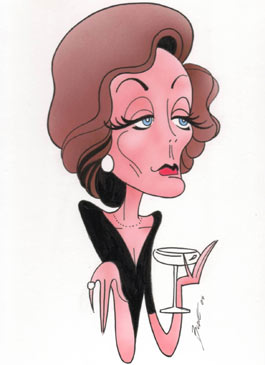
Caricature of Maggie Smith by Australian artist Col Bodie


Beautiful, just beautiful: Maggie Smith with her first husband Robert Stephens. The two were married between 1967 and 1974.


Maggie Smith and co-star Kelly MacDonald in what probably is my personal favourite Maggie Smith film, Robert Altman's Gosford Park (UK/ US 2002). I saw the film nine times in the cinema, own the DVD, the screenplay and the soundtrack, and can safely say that I know all of Maggie Smith's lines from that film by heart. Besides being a role that brings a new meaning to the word camp and thus is tailor-made for Maggie's talent, the entire film is superbly written and brilliantly cast.

A great actress: Maggie Smith